Inspector Blunt Never Needed an Elephant
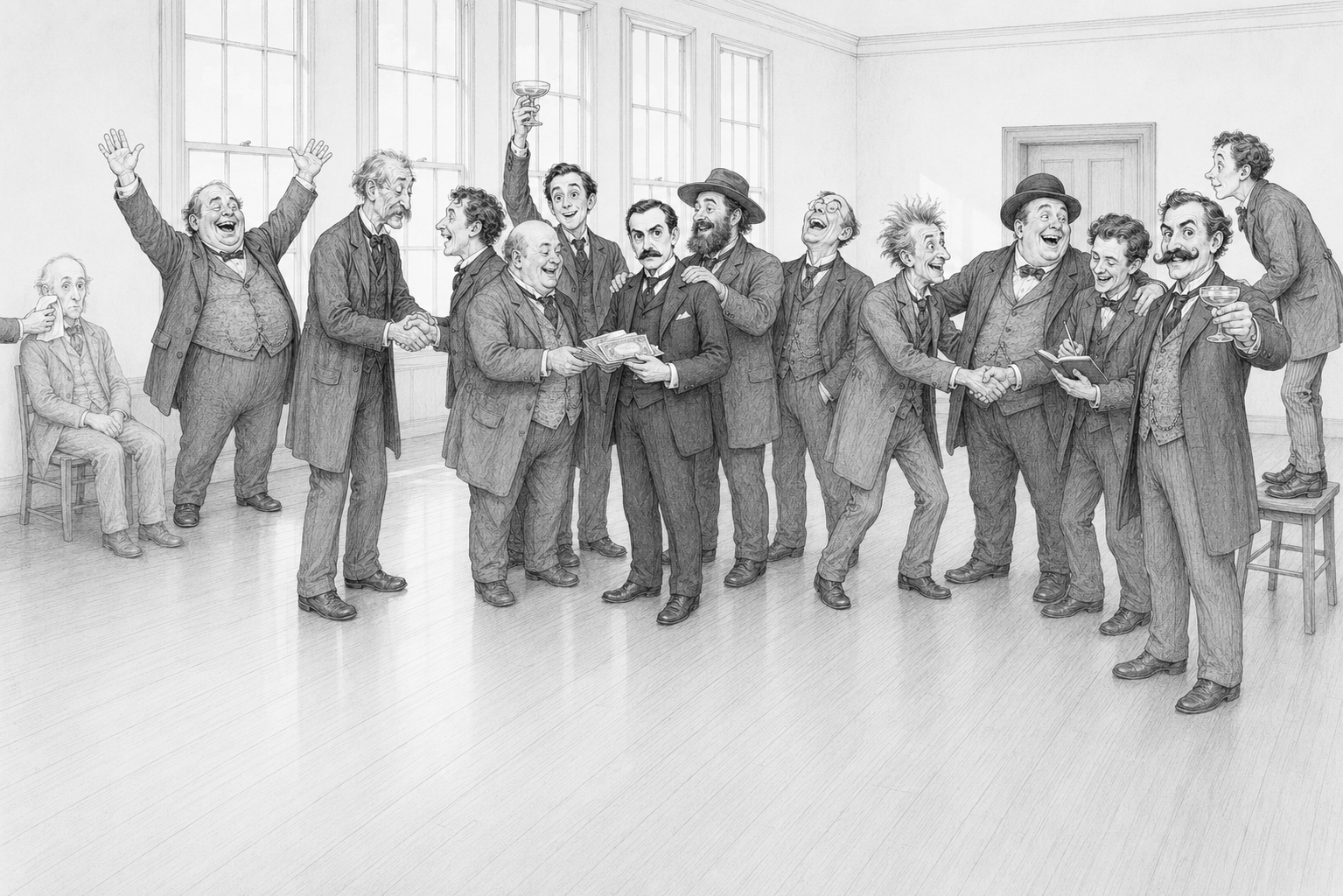
On “The Stolen White Elephant,” 1882
On Mark Twain’s story “The Stolen White Elephant,” 1882 · In the public domain
In 1882 Mark Twain published a detective story in which the detective detects nothing. A sacred white elephant, a diplomatic gift bound for the Queen of Britain, is stolen from a shed in Jersey City. The celebrated Inspector Blunt takes the case, mounts an investigation of magnificent thoroughness, spends a hundred and forty-two thousand dollars of his client’s money, and at last recovers the animal dead in his own basement, where it had been lying the entire time.
As detective fiction, it is a shaggy dog story with an elephant in it. The investigation is the part worth watching, and it gets more impressive the further it drifts from the animal it is meant to find.
The form is flawless
Blunt begins the way a competent professional begins. He takes down the elephant’s name, which runs to sixteen words. He asks for the given name, and is told Jumbo. He asks the place of birth. He asks whether the parents are living. He asks whether there was any other issue besides this one, and records that the animal was an only child.
Nothing in that sequence is stupid, and that is the first thing to notice. Every one of those questions belongs on a form. The form has simply never been read by anybody who stopped to ask what it was for.
Then he turns to the description, and asks his client to leave out no particular, however small, because in his profession there are no small particulars. How much would the animal eat at a meal? Five ordinary men. What nationalities would it prefer? It is indifferent to nationalities, though it does prefer acquaintances, and holds no prejudice against strangers. How many Bibles at a meal? An entire edition. And here Blunt objects.
It is hardly succinct enough. Do you mean the ordinary octavo, or the family illustrated?
The demand for precision is real. The precision is attached to nothing. That gap is the whole story, and Twain has laid it out inside the first ten minutes.
The reports do the work
Detectives go out under code names, a reward is posted, and the telegraph machine in the corner begins to click. What follows is a sustained joke built almost entirely out of paperwork, and it works because every wire is worse than the one before it while everybody in the room grows more confident.
Flower Station, N. Y., 7.30 a.m.Have got a clue. Found a succession of deep tracks across a farm near here. Followed them two miles east without result; think elephant went west. Shall now shadow him in that direction.
Barker’s, N. J., 7.40 a.m.Just arrived. Glass factory broken open here during night, and eight hundred bottles taken. Only water in large quantity near here is five miles distant. Shall strike for there. Elephant will be thirsty. Bottles were empty.
Coney Point, Pa., 8.45 a.m.Gas office broken open here during night and three months’ unpaid gas bills taken. Have got a clue and am away.
Sage Corners, N. Y., 10.30.Just arrived. Elephant passed through here at 8.15. All escaped from the town but a policeman. Apparently elephant did not strike at policeman, but at the lamp-post. Got both. I have secured a portion of the policeman as clue.
The detective at Flower Station has a moment worth pausing on. He follows the tracks three miles, meets the farmer who dug those holes to take out saplings for shade trees, and reports it. Blunt dictates the reply without any change in his voice: arrest the man, force him to name his accomplices, and continue to follow the tracks to the Pacific if necessary.
Read the wires together. Every detective has found something. None of them has found the elephant. All of them contain a clue, a theory, a direction, and a certainty. The output of the operation is the report. The elephant is a rumor the reports are about.
The evidence changes nothing
Blunt names two thieves early and never wavers. He knows their motives, their methods, and their movements. In the middle of the search two replies arrive from their families. One says that Brick Duffy has been dead two years. The other says that Red McFadden was hanged eighteen months ago, and adds that any ass but a detective would know it.
Nobody in the office makes a remark of any kind about either one. Twain does not underline it, and he does not need to. An operation that generates its own evidence has no mechanism for taking in news of this kind, so the news arrives, lands nowhere, and the theory continues.
Where the elephant was
Blunt eventually proposes a compromise. For one hundred thousand dollars he is confident he can recover the animal. The money is raised and handed over. He goes out into the night and comes back with his eyes flaming, takes up a candle, and leads his ruined client down into the vaulted basement where his sixty detectives sleep, and there, at the far end, stumbles over the body.
The elephant had been wounded in the confusion of the first night. It had crept into the one unfriendly place in the city, in among its hunters, and starved there, a few hundred feet under the beds of the men being paid to find it.
Then the reporters are called in and the champagne is opened. And a last telegram arrives from a detective a thousand miles away, still following footprints on horseback through the woods, reporting them fresher and bigger every day, and swearing he will have the elephant inside the week. Three cheers are ordered for him.
The last line
Twain has one more move, and it is the reason the story does not simply end as a farce.
I am a ruined man and a wanderer in the earth, but my admiration for that man, whom I believe to be the greatest detective the world has ever produced, remains undimmed to this day, and will so remain unto the end.
The man who lost everything is the operation’s most sincere defender. He is not being sarcastic, and he has not been silenced. His admiration, he tells us, remains undimmed, and the ruin at the end has not touched it. He watched the entire thing from the inside and came away convinced. The story’s nastiest joke is that failure does not automatically destroy an institution. The person it failed can keep vouching for it.
The target
Blunt’s genius, in Twain’s construction, is not solving the problem. It is making every stage of not solving it look like progress.
Twain aimed this at a specific target. Private detective agencies were a growing American business in 1882, and the most famous agencies built their reputations through publicity, case histories, and claims of professional expertise. Blunt handles his reporters personally and assures his client that the secrecy will be profound and absolute, and the next morning the whole affair is in every paper with a flattering portrait of him at his desk.
Change the letterhead and very little else moves.
A note on this page
Twain’s story is in the public domain, and the wires and lines quoted here are his, untouched. This page was produced with AI assistance and edited by R. M. Hume, who selected the story, wrote the notes, and made the final editorial decisions.
Read the edition
The illustrated story. Inspector Blunt and the whole investigation, retold and illustrated, on Kindle as The Stolen White Elephant, or in the Volume One paperback.
Read the annotated edition of The Stolen White Elephant →
More on Twain’s method: How Twain Said to Tell It →
Stay in the loop
New Twain editions and the occasional essay, straight to your inbox. Just that, nothing else.
You are joining updates from Mark Twain in an AI World. Just this, nothing else, unsubscribe anytime.