The Pinchbug and the Poodle
From The Adventures of Tom Sawyer, 1876 · In the public domain
Annotations and modern retelling © 2026 R. M. Hume
Before you begin, know that this is a church service that gets away from everyone in it, and that the boy at the center of the trouble could not be happier about it.
Tom Sawyer is stuck in a long, dry sermon on a warm morning, counting the pages and wishing he were anywhere else. Then he remembers the beetle in his pocket. What follows is one of the scenes readers remember longest from the book, a small riot that runs its course while the minister keeps trying to preach over it.
Watch how little Tom actually does. He lets a beetle loose, a stray dog finds it, and the rest unfolds on its own while the whole congregation fights not to laugh.
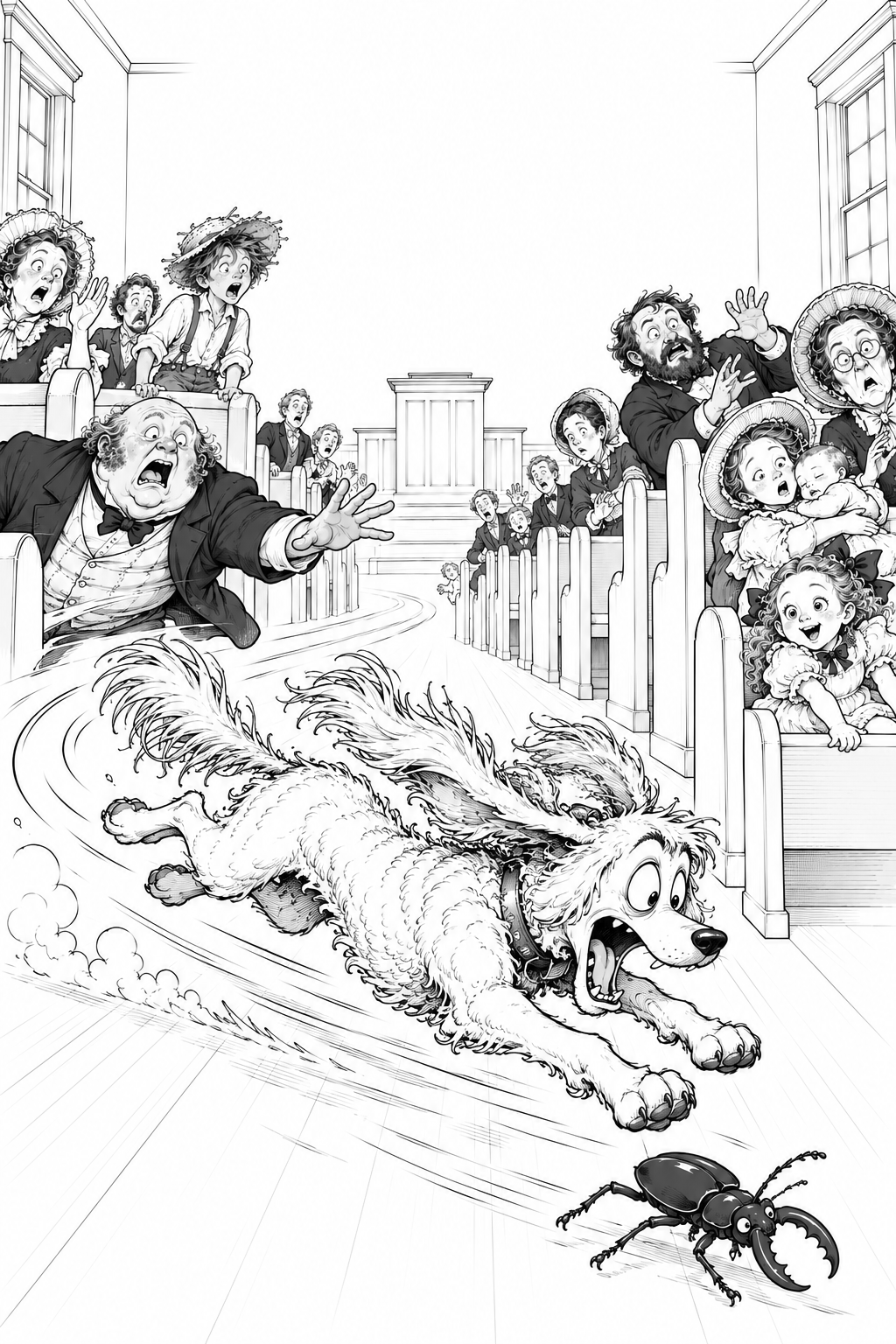
The Pinchbug and the Poodle
As Mark Twain wrote it, 1876
The minister gave out his text and droned along monotonously through an argument that was so prosy that many a head by and by began to nod—and yet it was an argument that dealt in limitless fire and brimstone and thinned the predestined elect down to a company so small as to be hardly worth the saving. Tom counted the pages of the sermon; after church he always knew how many pages there had been, but he seldom knew anything else about the discourse. However, this time he was really interested for a little while. The minister made a grand and moving picture of the assembling together of the world’s hosts at the millennium when the lion and the lamb should lie down together and a little child should lead them. But the pathos, the lesson, the moral of the great spectacle were lost upon the boy; he only thought of the conspicuousness of the principal character before the on-looking nations; his face lit with the thought, and he said to himself that he wished he could be that child, if it was a tame lion.
Now he lapsed into suffering again, as the dry argument was resumed. Presently he bethought him of a treasure he had and got it out. It was a large black beetle with formidable jaws—a “pinchbug,” he called it. It was in a percussion-cap box. The first thing the beetle did was to take him by the finger. A natural fillip followed, the beetle went floundering into the aisle and lit on its back, and the hurt finger went into the boy’s mouth. The beetle lay there working its helpless legs, unable to turn over. Tom eyed it, and longed for it; but it was safe out of his reach. Other people uninterested in the sermon found relief in the beetle, and they eyed it too. Presently a vagrant poodle dog came idling along, sad at heart, lazy with the summer softness and the quiet, weary of captivity, sighing for change. He spied the beetle; the drooping tail lifted and wagged. He surveyed the prize; walked around it; smelt at it from a safe distance; walked around it again; grew bolder, and took a closer smell; then lifted his lip and made a gingerly snatch at it, just missing it; made another, and another; began to enjoy the diversion; subsided to his stomach with the beetle between his paws, and continued his experiments; grew weary at last, and then indifferent and absent-minded. His head nodded, and little by little his chin descended and touched the enemy, who seized it. There was a sharp yelp, a flirt of the poodle’s head, and the beetle fell a couple of yards away, and lit on its back once more. The neighboring spectators shook with a gentle inward joy, several faces went behind fans and handkerchiefs, and Tom was entirely happy. The dog looked foolish, and probably felt so; but there was resentment in his heart, too, and a craving for revenge. So he went to the beetle and began a wary attack on it again; jumping at it from every point of a circle, lighting with his fore-paws within an inch of the creature, making even closer snatches at it with his teeth, and jerking his head till his ears flapped again. But he grew tired once more, after a while; tried to amuse himself with a fly but found no relief; followed an ant around, with his nose close to the floor, and quickly wearied of that; yawned, sighed, forgot the beetle entirely, and sat down on it. Then there was a wild yelp of agony and the poodle went sailing up the aisle; the yelps continued, and so did the dog; he crossed the house in front of the altar; he flew down the other aisle; he crossed before the doors; he clamored up the home-stretch; his anguish grew with his progress, till presently he was but a woolly comet moving in its orbit with the gleam and the speed of light. At last the frantic sufferer sheered from its course, and sprang into its master’s lap; he flung it out of the window, and the voice of distress quickly thinned away and died in the distance.
By this time the whole church was red-faced and suffocating with suppressed laughter, and the sermon had come to a dead standstill. The discourse was resumed presently, but it went lame and halting, all possibility of impressiveness being at an end; for even the gravest sentiments were constantly being received with a smothered burst of unholy mirth, under cover of some remote pew-back, as if the poor parson had said a rarely facetious thing. It was a genuine relief to the whole congregation when the ordeal was over and the benediction pronounced.
Tom Sawyer went home quite cheerful, thinking to himself that there was some satisfaction about divine service when there was a bit of variety in it. He had but one marring thought; he was willing that the dog should play with his pinchbug, but he did not think it was upright in him to carry it off.
The Pinchbug and the Poodle, Told Once More
A modern retelling by R. M. Hume
Church ran long that morning, and the sermon ran longer. The minister had a dry, winding argument about fire and brimstone, and he kept at it until even the congregation seemed to be running out of hope. Heads began to nod. Tom did what he always did in a sermon. He counted the pages. He could never tell you a word the man said, but he always knew to the page how long it had taken to say it.
When the dull part came back around, Tom remembered a treasure in his pocket and took it out. It was a big black beetle with a serious set of jaws, the kind he called a pinchbug, and he kept it in a little percussion-cap box. The first thing the beetle did was clamp onto his finger. Tom flicked it away without thinking, and it went skidding into the aisle and landed on its back, legs working, unable to right itself, while Tom sat there with the hurt finger in his mouth.
The beetle was out of reach now, and he could only look at it and wish he had it back. He was not the only one. Other people had given up on the sermon and were watching the beetle too. Then a stray poodle came wandering down the aisle, bored and sleepy and looking for anything at all to do. It found the beetle.
The dog’s whole mood changed. It circled the beetle, sniffed it, backed off, circled again, worked up its nerve, and began making careful little snaps at it, missing each time, then settling down on its belly to study the thing between its paws. After a while it got bored of that too, and its head began to droop, lower and lower, until its chin came down right on the beetle, and the beetle took hold.
There was a sharp yelp and a shake of the head, and the beetle went flying and landed on its back again. Up and down the pews, people shook with the kind of laughter you are not allowed to let out in church, and faces disappeared behind fans and handkerchiefs. Tom was having the best morning of his life. The dog, looking foolish and feeling worse, went back at the beetle out of pure spite, snapping and circling, until it got bored once more, wandered off after a fly and then an ant, forgot the whole business, and sat down on it.
This time the yelp was something else entirely. The poodle went up the aisle as if it had been fired from a gun, howling the whole way. It crossed in front of the altar, flew down the far aisle, shot past the doors, and came around again, louder with every lap, until it was less a dog than a small woolly comet streaking around the church. At last it gave up its orbit, sprang into its owner’s lap, and was flung out the window, where its howls thinned away into the distance.
By then the whole church was red-faced and trying not to laugh out loud, and the sermon had simply stopped. The minister started up again, but it was hopeless. Every solemn line he offered brought another smothered laugh from somewhere in the back. Everyone was relieved when it finally ended. Tom walked home well satisfied. There was something to be said for church, he decided, when it had a little variety in it. He had just one complaint. He did not mind the dog borrowing his pinchbug. He only thought it was a low thing to run off with it.
What Twain Was Doing
Twain published this in 1876, in the fifth chapter of The Adventures of Tom Sawyer, and the church scene is one of the purest pieces of slapstick he ever wrote. Nothing in it is explained. The whole thing is staged and then simply allowed to happen.
The trick is the boy’s-eye view. Twain reports the sermon the way Tom hears it, as pages to be counted rather than words to be heard, so by the time the beetle comes out of the box the reader is already as restless as Tom is. The comedy does not interrupt the service. It is the only relief in it.
Then watch the structure. The beetle bites, the dog finds it, the dog gets bored, the dog sits on it. Each beat is bigger than the last, and Twain spends his longest, most patient sentence on the poodle circling the beetle, because the slow build is what makes the final yelp land. He holds the chaos back until the room cannot stand it.
The deadpan never breaks. Twain describes a dog shot around a church like a comet in the same even voice he used for the dull sermon, and he lets the congregation do the laughing so he never has to. The funniest line is saved for last and handed to Tom, who objects not to the ruin of the service but to the theft of his bug.
It is the same method Twain runs everywhere, set in a pew. He takes the most solemn room in town, turns one small animal loose in it, and keeps a straight face while everything comes apart.
A Note on This Edition
Twain’s text is reproduced exactly as written in 1876. Nothing has been rewritten or modernized. The only additions within the passage are the annotations, which explain words, references, and historical context without changing the underlying text. The retelling below is the only rewritten version. The retelling and these notes were written by R. M. Hume with the help of AI.
This edition presents the church-service scene, which Twain placed in the fifth chapter of The Adventures of Tom Sawyer, followed by a modern retelling of that scene. It does not reproduce the rest of the chapter. The passage runs from the start of the sermon to Tom’s walk home, the sermon, the beetle, the poodle, and the aftermath, which is the comic heart of the chapter.
This is the second of the Tom Sawyer pieces in Mark Twain in an AI World, after the two collected volumes of his short stories and sketches. As in those, Twain’s own text sits word for word beside a plain modern retelling, so you can see exactly what was changed and what was not.
More on Twain’s method:
How Twain Said to Tell It →
·
The Rulebook Twain Hid in an Insult →