The Pain-Killer and the Cat
From The Adventures of Tom Sawyer, 1876 · In the public domain
Annotations and modern retelling © 2026 R. M. Hume
Before you begin, know that every hard thing Aunt Polly does in this story she does out of pure love, and that this is exactly what makes it funny.
Tom has been moping about the house, and his aunt, who believes in medicine the way other people believe good news, sets out to cure him. The water cure fails. Then she discovers Pain-Killer, and Tom, to get himself left alone, pretends to love it. What he does with it instead is the trouble.
Watch the two of them. Aunt Polly is tender and certain and completely wrong, and Tom meets the whole disaster with a straight face and the most innocent explanation a boy ever offered.
The Pain-Killer and the Cat
As Mark Twain wrote it, 1876
His aunt was concerned. She began to try all manner of remedies on him. She was one of those people who are infatuated with patent medicines and all new-fangled methods of producing health or mending it. She was an inveterate experimenter in these things. When something fresh in this line came out she was in a fever, right away, to try it; not on herself, for she was never ailing, but on anybody else that came handy. She was a subscriber for all the “Health” periodicals and phrenological frauds; and the solemn ignorance they were inflated with was breath to her nostrils. All the “rot” they contained about ventilation, and how to go to bed, and how to get up, and what to eat, and what to drink, and how much exercise to take, and what frame of mind to keep one’s self in, and what sort of clothing to wear, was all gospel to her, and she never observed that her health-journals of the current month customarily upset everything they had recommended the month before. She was as simple-hearted and honest as the day was long, and so she was an easy victim. She gathered together her quack periodicals and her quack medicines, and thus armed with death, went about on her pale horse, metaphorically speaking, with “hell following after.” But she never suspected that she was not an angel of healing and the balm of Gilead in disguise, to the suffering neighbors.
The water treatment was new, now, and Tom’s low condition was a windfall to her. She had him out at daylight every morning, stood him up in the wood-shed and drowned him with a deluge of cold water; then she scrubbed him down with a towel like a file, and so brought him to; then she rolled him up in a wet sheet and put him away under blankets till she sweated his soul clean and “the yellow stains of it came through his pores”—as Tom said.
Yet notwithstanding all this, the boy grew more and more melancholy and pale and dejected. She added hot baths, sitz baths, shower baths, and plunges. The boy remained as dismal as a hearse. She began to assist the water with a slim oatmeal diet and blister-plasters. She calculated his capacity as she would a jug’s, and filled him up every day with quack cure-alls.
Tom had become indifferent to persecution by this time. This phase filled the old lady’s heart with consternation. This indifference must be broken up at any cost. Now she heard of Pain-killer for the first time. She ordered a lot at once. She tasted it and was filled with gratitude. It was simply fire in a liquid form. She dropped the water treatment and everything else, and pinned her faith to Pain-killer. She gave Tom a teaspoonful and watched with the deepest anxiety for the result. Her troubles were instantly at rest, her soul at peace again; for the “indifference” was broken up. The boy could not have shown a wilder, heartier interest, if she had built a fire under him.
Tom felt that it was time to wake up; this sort of life might be romantic enough, in his blighted condition, but it was getting to have too little sentiment and too much distracting variety about it. So he thought over various plans for relief, and finally hit upon that of professing to be fond of Pain-killer. He asked for it so often that he became a nuisance, and his aunt ended by telling him to help himself and quit bothering her. If it had been Sid, she would have had no misgivings to alloy her delight; but since it was Tom, she watched the bottle clandestinely. She found that the medicine did really diminish, but it did not occur to her that the boy was mending the health of a crack in the sitting-room floor with it.
One day Tom was in the act of dosing the crack when his aunt’s yellow cat came along, purring, eyeing the teaspoon avariciously, and begging for a taste. Tom said:
“Don’t ask for it unless you want it, Peter.”
But Peter signified that he did want it.
“You better make sure.”
Peter was sure.
“Now you’ve asked for it, and I’ll give it to you, because there ain’t anything mean about me; but if you find you don’t like it, you mustn’t blame anybody but your own self.”
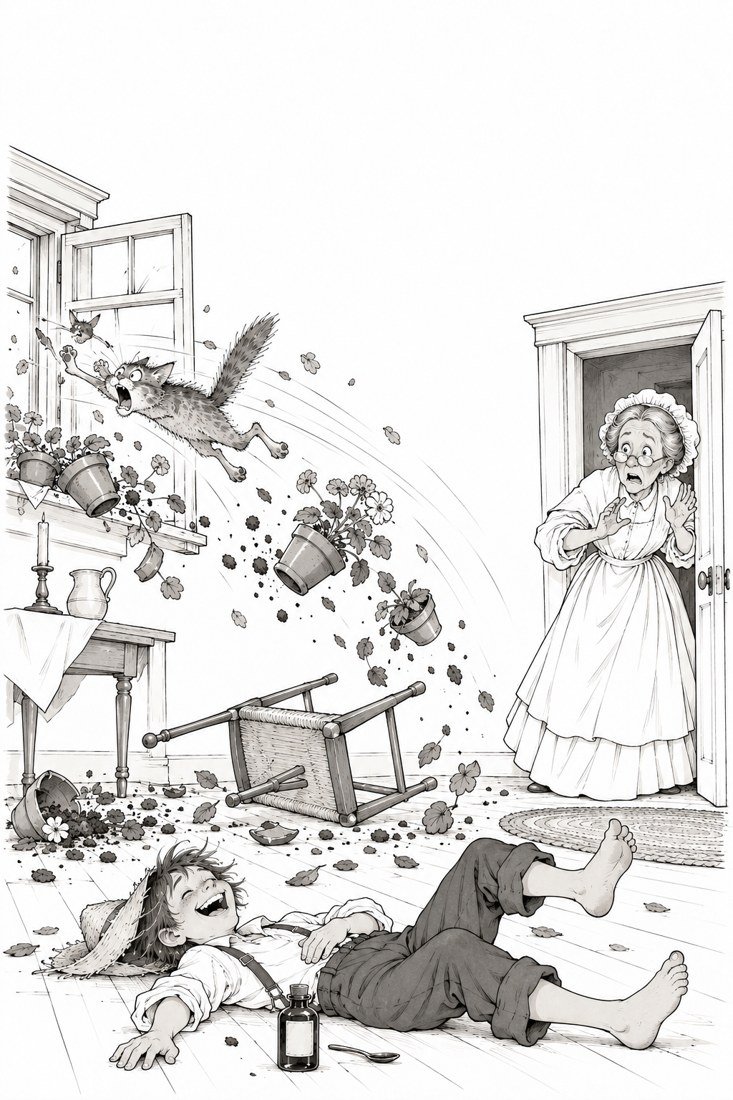
Peter was agreeable. So Tom pried his mouth open and poured down the Pain-killer. Peter sprang a couple of yards in the air, and then delivered a war-whoop and set off round and round the room, banging against furniture, upsetting flower-pots, and making general havoc. Next he rose on his hind feet and pranced around, in a frenzy of enjoyment, with his head over his shoulder and his voice proclaiming his unappeasable happiness. Then he went tearing around the house again spreading chaos and destruction in his path. Aunt Polly entered in time to see him throw a few double summersets, deliver a final mighty hurrah, and sail through the open window, carrying the rest of the flower-pots with him. The old lady stood petrified with astonishment, peering over her glasses; Tom lay on the floor expiring with laughter.
“Tom, what on earth ails that cat?”
“I don’t know, aunt,” gasped the boy.
“Why, I never see anything like it. What did make him act so?”
“Deed I don’t know, Aunt Polly; cats always act so when they’re having a good time.”
“They do, do they?” There was something in the tone that made Tom apprehensive.
“Yes’m. That is, I believe they do.”
“You do?”
“Yes’m.”
The old lady was bending down, Tom watching, with interest emphasized by anxiety. Too late he divined her “drift.” The handle of the telltale tea-spoon was visible under the bed-valance. Aunt Polly took it, held it up. Tom winced, and dropped his eyes. Aunt Polly raised him by the usual handle—his ear—and cracked his head soundly with her thimble.
“Now, sir, what did you want to treat that poor dumb beast so, for?”
“I done it out of pity for him—because he hadn’t any aunt.”
“Hadn’t any aunt!—you numskull. What has that got to do with it?”
“Heaps. Because if he’d had one she’d a burnt him out herself! She’d a roasted his bowels out of him ’thout any more feeling than if he was a human!”
Aunt Polly felt a sudden pang of remorse. This was putting the thing in a new light; what was cruelty to a cat might be cruelty to a boy, too. She began to soften; she felt sorry. Her eyes watered a little, and she put her hand on Tom’s head and said gently:
“I was meaning for the best, Tom. And, Tom, it did do you good.”
Tom looked up in her face with just a perceptible twinkle peeping through his gravity.
“I know you was meaning for the best, aunty, and so was I with Peter. It done him good, too. I never see him get around so since—”
“Oh, go ’long with you, Tom, before you aggravate me again. And you try and see if you can’t be a good boy, for once, and you needn’t take any more medicine.”
The Pain-Killer and the Cat, Told Once More
A modern retelling by R. M. Hume
Tom had been dragging around the house for days, pale and low and no use to anybody, and his aunt took it as her opportunity. She was one of those people who loved a new remedy the way other people love good news. Every health journal that came through the door, she read, and believed, and never once noticed that each month’s advice quietly undid the month before. When a fresh cure came along she could hardly wait to try it, never on herself, since she was never sick, but on whoever happened to be nearest. That month the nearest was Tom.
She started with the water cure. Every morning at daylight she stood him up in the woodshed and emptied a flood of cold water over him, scrubbed him down with a towel that felt like a file, then rolled him in a wet sheet and packed him under blankets until, as Tom put it, she sweated his soul clean and the yellow stains came through. When that only left him gloomier she added hot baths and cold baths and a thin diet of oatmeal, and filled him up every day with whatever the bottles promised.
Through all of it Tom went quiet. He stopped minding any of it, and that was the one thing his aunt could not bear, because a boy who had given up complaining was a boy who worried her. Then she heard about Pain-Killer. She ordered a good supply, tasted it once, and was won over completely. It was simply fire in liquid form. She gave Tom a spoonful and watched him with great tenderness, and whatever else you might say about the stuff, it did cure him of his calm. He came alive on the spot.
Tom decided he had to put a stop to it. He could not go on being doctored like this, so he hit on a plan. He began to claim that he loved Pain-Killer. He asked for it so constantly that his aunt finally told him to help himself and quit pestering her, which was exactly what he was after. After that the bottle kept going down, and she never suspected that Tom was feeding every dose to a crack in the sitting-room floor.
One afternoon, while he was busy medicating the floor, the family cat came strolling up, purring and eyeing the spoon and begging for a taste. Tom looked at him. “Don’t ask for it unless you want it, Peter,” he said. Peter wanted it. “You better make sure.” Peter was sure. “All right, you asked for it, and you will get it, because there is nothing mean about me. But if you find you don’t like it, you have only yourself to blame.”
Then he pried the cat’s mouth open and poured the dose down. Peter went straight up, a good two yards into the air, let out a war-whoop, and set off around the room like something that had come loose. He banged off the furniture, upset the flower-pots, rose on his hind legs and pranced, and then tore through the house spreading ruin in every direction. Aunt Polly came in just in time to see him turn a few somersaults, give one last mighty hurrah, and sail out the open window carrying the last of the flower-pots with him. She stood frozen, peering over her glasses. Tom was on the floor, helpless with laughter.
“Tom, what on earth is the matter with that cat?”
“I don’t know, aunt,” he managed.
“I never saw anything like it in my life. What made him act so?”
“I truly couldn’t say, Aunt Polly. Cats always go on that way when they are having a good time.”
“They do, do they?” There was something in the way she said it that made Tom uneasy.
“Yes, ma’am. At least, I believe they do.”
“You do?”
“Yes, ma’am.”
She bent down, and he watched her with the sharp interest that comes with dread. The handle of the telltale spoon was showing under the edge of the bed. She drew it out, held it up, and Tom’s eyes dropped to the floor. She lifted him by the usual handle, his ear, and cracked his head soundly with her thimble.
“Now then, what did you want to go and treat that poor dumb animal that way for?”
“I did it out of pity for him. He hasn’t got any aunt.”
“Hasn’t got any aunt, you numskull. What has that to do with it?”
“A good deal. Because if he had one, she would have burned him out herself. She would have roasted his insides right out of him, with no more feeling than if he were a human.”
Something in that reached her. It put the whole thing in a new light, and it struck her that what was cruelty in a cat might be cruelty in a boy as well. She softened, and felt sorry, and her eyes watered a little. She laid her hand on Tom’s head and told him, gently, that she had only meant it for his good, and that, besides, it truly had done him good.
Tom looked up at her with just the faintest twinkle working through his solemn face. “I know you meant it for the best, aunty. And so did I, with Peter. It did him good too. I never saw him get around so lively as he has since.”
“Oh, go on with you, Tom, before you start me off again. And see if you can be a good boy for once. You needn’t take any more medicine.”
What Twain Was Doing
Twain published this in 1876, in the twelfth chapter of The Adventures of Tom Sawyer. The engine of the scene is not the cat. It is Aunt Polly’s faith that there is a bottle for every trouble, and Twain builds that faith up carefully so that the Pain-Killer, when it arrives, feels inevitable rather than invented.
Then watch the escalation. The water cure, the oatmeal diet, the dosing, and then the one thing that truly alarms her, a boy who has stopped complaining. Each beat is bigger than the last, and the real reversal is quiet: the patient goes limp and the nurse is the one who comes undone. Only then does Twain let the comedy off its leash, and the cat goes off like fire in a liquid form.
The deadpan never breaks. A cat is launched through a window in the same even voice used for the water cure, and the funniest thing in the scene is not the chaos at all. It is Tom’s defense afterward, offered in total sincerity: he did it out of pity, because the poor cat has no aunt. Twain hands the last word to the boy, and the boy means every bit of it.
A Note on This Edition
Twain’s text is reproduced exactly as written in 1876. Nothing has been rewritten or modernized. The only additions within the passage are the annotations, which explain words, references, and historical context without changing the underlying text. The retelling below is the only rewritten version. The retelling and these notes were written by R. M. Hume with the help of AI.
This edition presents the Pain-Killer scene, which Twain placed in the twelfth chapter of The Adventures of Tom Sawyer, followed by a modern retelling of that scene. The passage runs from Aunt Polly’s doctoring to her last word to Tom, the water cure, the Pain-Killer, the cat, and the aftermath, which is the comic heart of the chapter. It does not reproduce the Becky Thatcher thread that opens and closes the chapter around it.
This is the third of the Tom Sawyer pieces in Mark Twain in an AI World, alongside Whitewashing the Fence and The Pinchbug and the Poodle. As in the rest of the series, Twain’s own text sits word for word beside a plain modern retelling, so you can see exactly what was changed and what was not.
More on Twain’s method:
How Twain Said to Tell It →
·
The Rulebook Twain Hid in an Insult →