The Sunday-School Prize
From The Adventures of Tom Sawyer, 1876 · In the public domain
Annotations and modern retelling © 2026 R. M. Hume
Before you begin, know that the prize in this story is a cheap little Bible, the kind that sold for about forty cents, and that most children spent two patient years of recited verses to earn one. Tom earns his in a single morning, and not one verse of Scripture is involved.
The Sunday-school ran on tickets. You recited your verses, you collected your tickets, and ten of one color traded up for one of the next, until at last a stack of them bought the Bible. Tom had no verses. What he had was a pocketful of odds and ends and a gift for trade, and that morning, with a county judge watching and every teacher performing, he walked up with a fistful of other boys’ tickets and asked for his prize.
Watch who the joke is really on. It is not the children. It is the grown-ups, so busy showing off for the great man that not one of them stops to wonder how the least likely boy in the school came by the prize.
The Sunday-School Prize
As Mark Twain wrote it, 1876
At the door Tom dropped back a step and accosted a Sunday-dressed comrade:
“Say, Billy, got a yaller ticket?”
“Yes.”
“What’ll you take for her?”
“What’ll you give?”
“Piece of lickrish and a fish-hook.”
“Less see ’em.”
Tom exhibited. They were satisfactory, and the property changed hands. Then Tom traded a couple of white alleys for three red tickets, and some small trifle or other for a couple of blue ones. He waylaid other boys as they came, and went on buying tickets of various colors ten or fifteen minutes longer. He entered the church, now, with a swarm of clean and noisy boys and girls, proceeded to his seat and started a quarrel with the first boy that came handy. The teacher, a grave, elderly man, interfered; then turned his back a moment and Tom pulled a boy’s hair in the next bench, and was absorbed in his book when the boy turned around; stuck a pin in another boy, presently, in order to hear him say “Ouch!” and got a new reprimand from his teacher. Tom’s whole class were of a pattern—restless, noisy, and troublesome. When they came to recite their lessons, not one of them knew his verses perfectly, but had to be prompted all along. However, they worried through, and each got his reward—in small blue tickets, each with a passage of Scripture on it; each blue ticket was pay for two verses of the recitation. Ten blue tickets equalled a red one, and could be exchanged for it; ten red tickets equalled a yellow one; for ten yellow tickets the superintendent gave a very plainly bound Bible (worth forty cents in those easy times) to the pupil. How many of my readers would have the industry and application to memorize two thousand verses, even for a Doré Bible? And yet Mary had acquired two Bibles in this way—it was the patient work of two years—and a boy of German parentage had won four or five. He once recited three thousand verses without stopping; but the strain upon his mental faculties was too great, and he was little better than an idiot from that day forth—a grievous misfortune for the school, for on great occasions, before company, the superintendent (as Tom expressed it) had always made this boy come out and “spread himself.” Only the older pupils managed to keep their tickets and stick to their tedious work long enough to get a Bible, and so the delivery of one of these prizes was a rare and noteworthy circumstance; the successful pupil was so great and conspicuous for that day that on the spot every scholar’s heart was fired with a fresh ambition that often lasted a couple of weeks. It is possible that Tom’s mental stomach had never really hungered for one of those prizes, but unquestionably his entire being had for many a day longed for the glory and the eclat that came with it.
In due course the superintendent stood up in front of the pulpit, with a closed hymn-book in his hand and his forefinger inserted between its leaves, and commanded attention. When a Sunday-school superintendent makes his customary little speech, a hymn-book in the hand is as necessary as is the inevitable sheet of music in the hand of a singer who stands forward on the platform and sings a solo at a concert—though why, is a mystery: for neither the hymn-book nor the sheet of music is ever referred to by the sufferer. This superintendent was a slim creature of thirty-five, with a sandy goatee and short sandy hair; he wore a stiff standing-collar whose upper edge almost reached his ears and whose sharp points curved forward abreast the corners of his mouth—a fence that compelled a straight lookout ahead, and a turning of the whole body when a side view was required; his chin was propped on a spreading cravat which was as broad and as long as a bank-note, and had fringed ends; his boot toes were turned sharply up, in the fashion of the day, like sleigh-runners—an effect patiently and laboriously produced by the young men by sitting with their toes pressed against a wall for hours together. Mr. Walters was very earnest of mien, and very sincere and honest at heart; and he held sacred things and places in such reverence, and so separated them from worldly matters, that unconsciously to himself his Sunday-school voice had acquired a peculiar intonation which was wholly absent on week-days. He began after this fashion:
“Now, children, I want you all to sit up just as straight and pretty as you can and give me all your attention for a minute or two. There—that is it. That is the way good little boys and girls should do. I see one little girl who is looking out of the window—I am afraid she thinks I am out there somewhere—perhaps up in one of the trees making a speech to the little birds. [Applausive titter.] I want to tell you how good it makes me feel to see so many bright, clean little faces assembled in a place like this, learning to do right and be good.” And so forth and so on. It is not necessary to set down the rest of the oration. It was of a pattern which does not vary, and so it is familiar to us all.
The latter third of the speech was marred by the resumption of fights and other recreations among certain of the bad boys, and by fidgetings and whisperings that extended far and wide, washing even to the bases of isolated and incorruptible rocks like Sid and Mary. But now every sound ceased suddenly, with the subsidence of Mr. Walters’ voice, and the conclusion of the speech was received with a burst of silent gratitude.
A good part of the whispering had been occasioned by an event which was more or less rare—the entrance of visitors: lawyer Thatcher, accompanied by a very feeble and aged man; a fine, portly, middle-aged gentleman with iron-gray hair; and a dignified lady who was doubtless the latter’s wife. The lady was leading a child. Tom had been restless and full of chafings and repinings; conscience-smitten, too—he could not meet Amy Lawrence’s eye, he could not brook her loving gaze. But when he saw this small newcomer his soul was all ablaze with bliss in a moment. The next moment he was “showing off” with all his might—cuffing boys, pulling hair, making faces—in a word, using every art that seemed likely to fascinate a girl and win her applause. His exaltation had but one alloy—the memory of his humiliation in this angel’s garden—and that record in sand was fast washing out, under the waves of happiness that were sweeping over it now.
The visitors were given the highest seat of honor, and as soon as Mr. Walters’ speech was finished, he introduced them to the school. The middle-aged man turned out to be a prodigious personage—no less a one than the county judge—altogether the most august creation these children had ever looked upon—and they wondered what kind of material he was made of—and they half wanted to hear him roar, and were half afraid he might, too. He was from Constantinople, twelve miles away—so he had travelled, and seen the world—these very eyes had looked upon the county court-house—which was said to have a tin roof. The awe which these reflections inspired was attested by the impressive silence and the ranks of staring eyes. This was the great Judge Thatcher, brother of their own lawyer. Jeff Thatcher immediately went forward, to be familiar with the great man and be envied by the school. It would have been music to his soul to hear the whisperings:
“Look at him, Jim! He’s a going up there. Say—look! he’s a going to shake hands with him—he is shaking hands with him! By jings, don’t you wish you was Jeff?”
Mr. Walters fell to “showing off,” with all sorts of official bustlings and activities, giving orders, delivering judgments, discharging directions here, there, everywhere that he could find a target. The librarian “showed off”—running hither and thither with his arms full of books and making a deal of the splutter and fuss that insect authority delights in. The young lady teachers “showed off”—bending sweetly over pupils that were lately being boxed, lifting pretty warning fingers at bad little boys and patting good ones lovingly. The young gentlemen teachers “showed off” with small scoldings and other little displays of authority and fine attention to discipline—and most of the teachers, of both sexes, found business up at the library, by the pulpit; and it was business that frequently had to be done over again two or three times (with much seeming vexation). The little girls “showed off” in various ways, and the little boys “showed off” with such diligence that the air was thick with paper wads and the murmur of scufflings. And above it all the great man sat and beamed a majestic judicial smile upon all the house, and warmed himself in the sun of his own grandeur—for he was “showing off,” too.
There was only one thing wanting to make Mr. Walters’ ecstasy complete, and that was a chance to deliver a Bible-prize and exhibit a prodigy. Several pupils had a few yellow tickets, but none had enough—he had been around among the star pupils inquiring. He would have given worlds, now, to have that German lad back again with a sound mind.
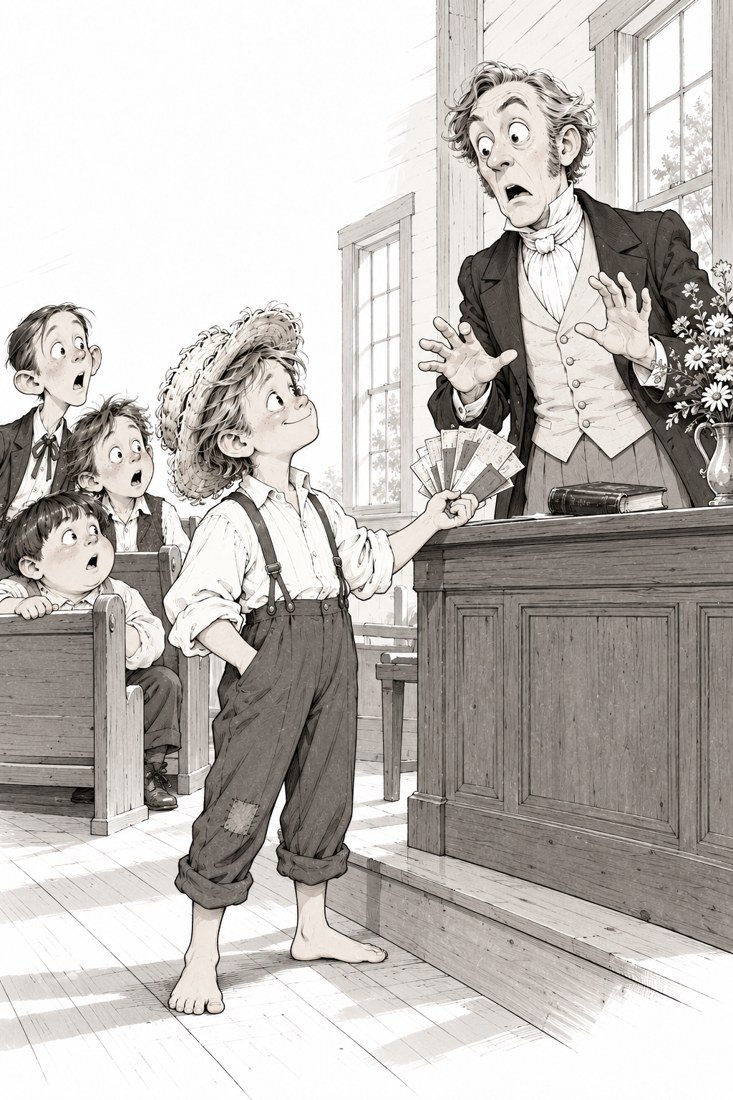
And now at this moment, when hope was dead, Tom Sawyer came forward with nine yellow tickets, nine red tickets, and ten blue ones, and demanded a Bible. This was a thunderbolt out of a clear sky. Walters was not expecting an application from this source for the next ten years. But there was no getting around it—here were the certified checks, and they were good for their face. Tom was therefore elevated to a place with the Judge and the other elect, and the great news was announced from headquarters. It was the most stunning surprise of the decade, and so profound was the sensation that it lifted the new hero up to the judicial one’s altitude, and the school had two marvels to gaze upon in place of one. The boys were all eaten up with envy—but those that suffered the bitterest pangs were those who perceived too late that they themselves had contributed to this hated splendor by trading tickets to Tom for the wealth he had amassed in selling whitewashing privileges. These despised themselves, as being the dupes of a wily fraud, a guileful snake in the grass.
The prize was delivered to Tom with as much effusion as the superintendent could pump up under the circumstances; but it lacked somewhat of the true gush, for the poor fellow’s instinct taught him that there was a mystery here that could not well bear the light, perhaps; it was simply preposterous that this boy had warehoused two thousand sheaves of Scriptural wisdom on his premises—a dozen would strain his capacity, without a doubt.
Amy Lawrence was proud and glad, and she tried to make Tom see it in her face—but he wouldn’t look. She wondered; then she was just a grain troubled; next a dim suspicion came and went—came again; she watched; a furtive glance told her worlds—and then her heart broke, and she was jealous, and angry, and the tears came and she hated everybody. Tom most of all (she thought).
Tom was introduced to the Judge; but his tongue was tied, his breath would hardly come, his heart quaked—partly because of the awful greatness of the man, but mainly because he was her parent. He would have liked to fall down and worship him, if it were in the dark. The Judge put his hand on Tom’s head and called him a fine little man, and asked him what his name was. The boy stammered, gasped, and got it out:
“Tom.”
“Oh, no, not Tom—it is—”
“Thomas.”
“Ah, that’s it. I thought there was more to it, maybe. That’s very well. But you’ve another one I daresay, and you’ll tell it to me, won’t you?”
“Tell the gentleman your other name, Thomas,” said Walters, “and say sir. You mustn’t forget your manners.”
“Thomas Sawyer—sir.”
“That’s it! That’s a good boy. Fine boy. Fine, manly little fellow. Two thousand verses is a great many—very, very great many. And you never can be sorry for the trouble you took to learn them; for knowledge is worth more than anything there is in the world; it’s what makes great men and good men; you’ll be a great man and a good man yourself, some day, Thomas, and then you’ll look back and say, It’s all owing to the precious Sunday-school privileges of my boyhood—it’s all owing to my dear teachers that taught me to learn—it’s all owing to the good superintendent, who encouraged me, and watched over me, and gave me a beautiful Bible—a splendid elegant Bible—to keep and have it all for my own, always—it’s all owing to right bringing up! That is what you will say, Thomas—and you wouldn’t take any money for those two thousand verses—no indeed you wouldn’t. And now you wouldn’t mind telling me and this lady some of the things you’ve learned—no, I know you wouldn’t—for we are proud of little boys that learn. Now, no doubt you know the names of all the twelve disciples. Won’t you tell us the names of the first two that were appointed?”
Tom was tugging at a button-hole and looking sheepish. He blushed, now, and his eyes fell. Mr. Walters’ heart sank within him. He said to himself, it is not possible that the boy can answer the simplest question—why did the Judge ask him? Yet he felt obliged to speak up and say:
“Answer the gentleman, Thomas—don’t be afraid.”
Tom still hung fire.
“Now I know you’ll tell me,” said the lady. “The names of the first two disciples were—”
“David and Goliah!”
Let us draw the curtain of charity over the rest of the scene.
The Sunday-School Prize, Told Once More
A modern retelling by R. M. Hume
Getting to Sunday-school was one thing. Getting the prize was another, and Tom had a system for that.
At the church door he dropped back a step and sized up a boy in his Sunday clothes. “Say, Billy, got a yellow ticket?” Billy had. “What will you take for it?” “What will you give?” A piece of licorice and a fish-hook changed hands, and so did the ticket. From there Tom went to work on the other boys as they filed in, trading a couple of marbles for red tickets and this and that for blue ones, until after a quarter of an hour of steady business he had a pocketful.
The tickets were the whole point of the place. A child earned a little blue ticket for every two Bible verses he could recite. Ten blue tickets traded up for a red one, ten red for a yellow, and ten yellow tickets won a plainly bound Bible worth about forty cents in those easy times. It took most children two patient years of memorizing to get there, so the handing over of a Bible was a rare and splendid event, and for one whole day the winner was the most important person in the room. Tom had never once hungered to actually learn two thousand verses. He had only ever hungered for the glory of the day the prize was given out.
Then he went in and took his seat the way he always did, by picking a quarrel with the first boy he reached, pulling the hair of the boy in the next bench, and working a pin into a third just to hear him say “Ouch.” His teacher reprimanded him, which was about what he expected.
That morning the schoolroom had visitors, and the whole place fell to whispering. Lawyer Thatcher had come in with a feeble old man, a fine portly gentleman with iron-gray hair, and a dignified lady leading a little girl by the hand. The portly gentleman turned out to be a tremendous personage, the county judge himself, who had come all the way from a town twelve miles off and had actually seen the world. The children stared at him and half hoped he might roar.
At that, everybody set to showing off. Mr. Walters the superintendent showed off by bustling about and giving orders in every direction. The librarian showed off by hurrying back and forth with his arms full of books. The young lady teachers showed off by bending sweetly over pupils they had been cuffing a minute before, and the young men teachers showed off with little scoldings and displays of discipline, and the great judge sat above it all and beamed a broad judicial smile, showing off too. Tom showed off hardest of all, cuffing and shoving and making faces, using every art he had to win one look from the little girl.
There was only one thing missing from Mr. Walters’ happiness, and that was a chance to hand out a Bible prize with the judge there to see it. He had been around among the star pupils asking, and not one of them had tickets enough. And then, at the very moment hope was dead, Tom Sawyer walked up with nine yellow tickets, nine red, and ten blue, and asked for a Bible.
It was a thunderbolt out of a clear sky. Walters had not expected an application from that quarter for the next ten years, but there was no getting around it. The tickets were real and they were paid in full. Tom was marched up to sit among the great, and the news went out from headquarters. The other boys were eaten up with envy, and the ones who suffered worst were the ones who slowly understood that they had paid for this glory themselves, trading their hard-won tickets to Tom for the riches he had piled up selling off the privilege of whitewashing a fence. They had been taken in by a sly and guileful fraud, and now they knew it.
The prize was handed over with as much warmth as the superintendent could manage, though it came out a little thin, because something in him suspected a mystery here that would not bear looking at too closely. The idea that this particular boy had two thousand verses of Scripture stored away was, on the face of it, preposterous.
Then Tom was brought up to the judge, and his tongue tied itself and his heart pounded, partly from the awful greatness of the man and mostly because the man was the little girl’s father. The judge put a hand on Tom’s head, called him a fine little man, and asked him his name.
“Thomas Sawyer, sir.”
“That’s it. That’s a good boy. Fine, manly little fellow. Two thousand verses is a great many, very, very many. And you’ll never be sorry you took the trouble to learn them, for knowledge is worth more than anything there is in the world. It’s what makes great men and good men. You’ll be a great man and a good man yourself one day, Thomas, and then you’ll look back and say it is all owing to the dear Sunday-school of your boyhood, and to your teachers, and to your good superintendent who gave you a fine Bible to keep for your own. That is what you’ll say. And now you wouldn’t mind telling me and this lady a few of the things you’ve learned. No, I know you wouldn’t. Now, you surely know the names of all twelve of the disciples. Won’t you tell us the names of the first two that were chosen?”
Tom tugged at a buttonhole and looked sheepish. He blushed, and his eyes fell. Mr. Walters’ heart sank, for he said to himself that the boy could not answer the simplest question in the world, and why on earth had the judge asked him. Still, he felt he had to speak up. “Answer the gentleman, Thomas. Don’t be afraid.”
Tom still hung fire.
“Now I know you’ll tell me,” said the lady. “The names of the first two disciples were,”
“David and Goliath!”
Let us draw the curtain of charity over the rest of the scene.
What Twain Was Doing
Twain published this in 1876, in the fourth chapter of The Adventures of Tom Sawyer. The engine of the scene is an incentive and the way a clever boy games it. The Sunday-school paid tickets for recited verses and let a child trade up, ten of one for one of the next, until a pile of them bought a Bible. The system was built to reward learning. Tom proves it rewards whoever best works the system.
Then watch the showing-off. A visiting judge arrives, and the whole room performs for him. The superintendent bustles and gives orders, the teachers fuss sweetly over children they had been cuffing a minute before, and the judge beams down on all of it. The vanity is general, and it is the vanity, not the boy, that sets up the fall.
The reversal is quiet. Tom gets his prize, and the only person who suspects anything is the superintendent, who would rather the mystery stayed buried, because handing out the Bible with the judge watching is his moment too. Then the judge, charmed, asks one simple question, and the deadpan holds right up to the blurted wrong answer. Twain draws the curtain of charity and lets the reader finish the scene.
A Note on This Edition
Twain’s text is reproduced exactly as written in 1876. Nothing has been rewritten or modernized. The only additions within the passage are the annotations, which explain words, references, and historical context without changing the underlying text. The retelling below is the only rewritten version. The retelling and these notes were written by R. M. Hume with the help of AI.
This edition presents the Sunday-school prize scene, which Twain placed in the fourth chapter of The Adventures of Tom Sawyer, followed by a modern retelling of that scene. The passage runs from Tom working the church door for tickets to the blurted wrong answer and the curtain of charity, which is the comic heart of the chapter. It does not reproduce the family-worship opening, in which Tom fails to learn his verses and is washed and dressed for church. The little girl is left unnamed, exactly as Twain leaves her here.
This is the fourth of the Tom Sawyer pieces in Mark Twain in an AI World, alongside Whitewashing the Fence, The Pinchbug and the Poodle, and The Pain-Killer and the Cat. As in the rest of the series, Twain’s own text sits word for word beside a plain modern retelling, so you can see exactly what was changed and what was not.
More on Twain’s method:
How Twain Said to Tell It →
·
The Rulebook Twain Hid in an Insult →