The Cadets of Temperance
A selected passage from The Adventures of Tom Sawyer, 1876 · In the public domain
Annotations and modern retelling © 2026 R. M. Hume
Before you begin, know that Tom Sawyer has found something worth joining: the Cadets of Temperance. The members wear splendid red sashes, and Tom can already picture himself marching in one.
There is just one small condition. To wear the sash, he has to give up smoking, chewing, and swearing.
Tom has never been much good at giving things up. And this time, the promise itself may turn out to be the hardest part.
The Cadets of Temperance
As Mark Twain wrote it, 1876 · The Adventures of Tom Sawyer, Chapter XXII (selected passage)
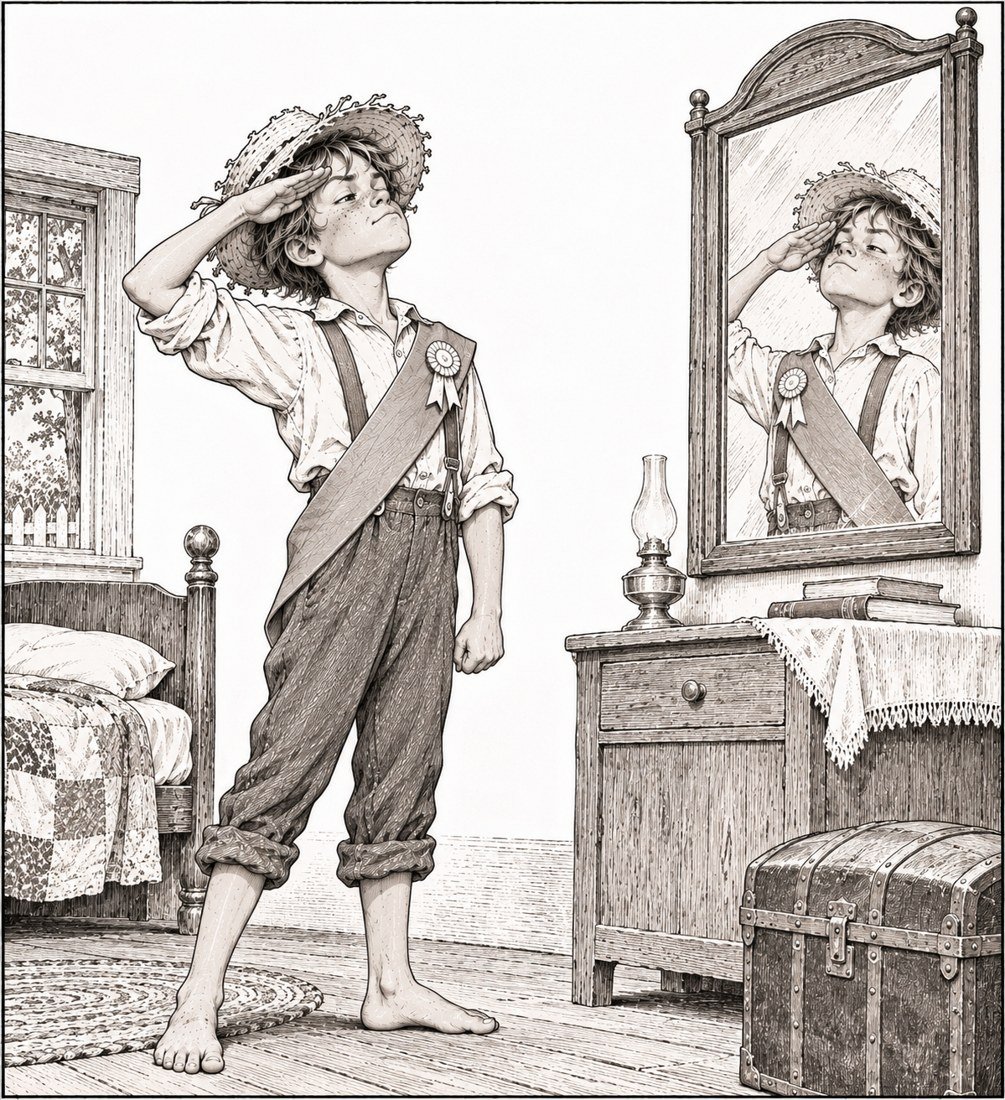
TOM joined the new order of Cadets of Temperance, being attracted by the showy character of their “regalia.” He promised to abstain from smoking, chewing, and profanity as long as he remained a member. Now he found out a new thing — namely, that to promise not to do a thing is the surest way in the world to make a body want to go and do that very thing. Tom soon found himself tormented with a desire to drink and swear; the desire grew to be so intense that nothing but the hope of a chance to display himself in his red sash kept him from withdrawing from the order. Fourth of July was coming; but he soon gave that up — gave it up before he had worn his shackles over forty-eight hours — and fixed his hopes upon old Judge Frazer, justice of the peace, who was apparently on his deathbed and would have a big public funeral, since he was so high an official. During three days Tom was deeply concerned about the Judge’s condition and hungry for news of it. Sometimes his hopes ran high — so high that he would venture to get out his regalia and practise before the looking-glass. But the Judge had a most discouraging way of fluctuating. At last he was pronounced upon the mend — and then convalescent. Tom was disgusted; and felt a sense of injury, too. He handed in his resignation at once — and that night the Judge suffered a relapse and died. Tom resolved that he would never trust a man like that again.
The funeral was a fine thing. The Cadets paraded in a style calculated to kill the late member with envy. Tom was a free boy again, however — there was something in that. He could drink and swear, now — but found to his surprise that he did not want to. The simple fact that he could, took the desire away, and the charm of it.
The Cadets of Temperance, Told Once More
A modern retelling by R. M. Hume
Tom joined the Cadets of Temperance. What won him over was not the cause but the costume. The Cadets had a showy red sash and a set of regalia, and Tom wanted badly to be seen in one. The price of joining was a promise to give up smoking, chewing, and swearing for as long as he stayed a member.
He soon discovered that promising not to do something was the fastest way in the world to make yourself ache to do it. Tom had barely taken the pledge before a craving to drink and swear came over him, and it grew so fierce that the only thing holding him in the order was the thought of showing himself off in that red sash.
He needed an occasion to parade in. The Fourth of July was coming, and he fixed his hopes on that, then gave it up before he had worn his pledge even two days. So he pinned everything on old Judge Frazer, the justice of the peace, who was lying on his deathbed. A man that important would get a grand public funeral, and a funeral meant a procession, and a procession meant the sash.
For three days Tom watched the Judge’s health anxiously, waiting for every scrap of news. His hopes rose and fell with each report. When they ran high he would take his regalia out and practice in front of the mirror. But the old man had a maddening habit of rallying. First he was said to be mending. Then he was called out of danger. Then, worst of all, he was pronounced recovering.
Tom was disgusted and felt a little cheated too, as though the Judge had let him down on purpose. He handed in his resignation then and there.
That night the Judge took a turn, relapsed, and died.
Tom decided he would never trust a man like that again.
The funeral was everything he could have hoped for, and he watched it from the outside. The Cadets paraded in a style calculated to make their lost member sick with envy. But Tom was a free boy now, and there was something in that too. He could drink and swear again whenever he liked. And to his great surprise, he found that he no longer wanted to. Being allowed to do it had pulled all the temptation out of it, and the charm was gone.
What Twain Was Doing
Twain published this in 1876, in the twenty-second chapter of The Adventures of Tom Sawyer. The Cadets episode runs on one simple truth about people, told almost as a fable. Tom takes a vow he has no interest in keeping, for a prize (the sash) that has nothing to do with the vow, and the forbidding is what makes him crave the thing. Twain states the rule plainly, then lets Tom act it out.
What drives the comedy is the deathwatch. Tom’s hunger for a parade turns a dying man into an opportunity, and Twain plays the boy’s self-interest for exactly what it is, ugly and completely familiar. The Judge’s habit of rallying feels to Tom like a personal affront. His recovery is a betrayal, and the timing of his death, the very night Tom quits, is the punchline.
Then Twain lands the quieter point. Freed to do the forbidden things, Tom no longer wants them, because being forbidden was the whole appeal. Twain does not spell out the lesson. He lets the boy find it and moves on, and that is why it reads as something true rather than a sermon.
A Note on This Edition
Twain’s text is reproduced verbatim from the 1876 publication, with the one typographic normalization used across this series: the original double hyphens are set as em dashes. Nothing has been rewritten or modernized. The only additions within the passage are the annotations, which explain words and references without changing the underlying text. The retelling below is the only rewritten version. The retelling and these notes were written by R. M. Hume with the help of AI.
This is a selected passage from the twenty-second chapter of The Adventures of Tom Sawyer, the Cadets of Temperance episode, not the whole chapter. The vacation sketches that follow it in the chapter are a separate string of incidents and are not part of this scene.
This is one of the Tom Sawyer pieces in Mark Twain in an AI World, alongside Whitewashing the Fence, The Pinchbug and the Poodle, The Pain-Killer and the Cat, The Sunday-School Prize, Examination Evening, The Tick in School, Tom and Becky’s First Courtship, Jackson’s Island, and Tom Takes Becky’s Whipping. As in the rest of the series, Twain’s own text sits word for word beside a plain modern retelling, so you can see exactly what was changed and what was not.
More on Twain’s method:
How Twain Said to Tell It →
·
The Rulebook Twain Hid in an Insult →