The Invalid’s Story
Annotated Edition, with the technique behind the joke
Original story from How to Tell a Story and Other Essays · Written about 1877 · In the public domain
Annotations and modern retelling © 2026 R. M. Hume
Here is a small mercy the reader gets that the narrator never does. You are told the truth on the first page, and he does not learn it until the last. He believes he is shut in a sealed railway car with the ripening body of a dead friend. You know it is a crate of rifles and a wheel of cheese. Everything funny in the story lives in that gap.
What makes this the right story to carry forward next is where Twain put it. He published it inside a volume that opens with his own lecture on humor, his rules for how a comic story is built and told. So we run the two together. First the story, then the method, so you can watch the trick work and then meet the hand that worked it. The question underneath the whole edition is the one the age of AI keeps asking. Can a tin ear keep a straight face, or does it always wink?
You will always know whose words you are reading. Twain’s original story comes first, word for word, and the modern retelling after it is new writing in R. M. Hume’s words, not Twain’s.
The Invalid’s Story
As Mark Twain wrote it, 1882
I seem sixty and married, but these effects are due to my condition and sufferings, for I am a bachelor, and only forty-one. It will be hard for you to believe that I, who am now but a shadow, was a hale, hearty man two short years ago, a man of iron, a very athlete!—yet such is the simple truth. But stranger still than this fact is the way in which I lost my health. I lost it through helping to take care of a box of guns on a two-hundred-mile railway journey one winter’s night. It is the actual truth, and I will tell you about it.
I belong in Cleveland, Ohio. One winter’s night, two years ago, I reached home just after dark, in a driving snow-storm, and the first thing I heard when I entered the house was that my dearest boyhood friend and schoolmate, John B. Hackett, had died the day before, and that his last utterance had been a desire that I would take his remains home to his poor old father and mother in Wisconsin. I was greatly shocked and grieved, but there was no time to waste in emotions; I must start at once. I took the card, marked “Deacon Levi Hackett, Bethlehem, Wisconsin,” and hurried off through the whistling storm to the railway station. Arrived there I found the long white-pine box which had been described to me; I fastened the card to it with some tacks, saw it put safely aboard the express car, and then ran into the eating-room to provide myself with a sandwich and some cigars. When I returned, presently, there was my coffin-box back again, apparently, and a young fellow examining around it, with a card in his hands, and some tacks and a hammer! I was astonished and puzzled. He began to nail on his card, and I rushed out to the express car, in a good deal of a state of mind, to ask for an explanation. But no—there was my box, all right, in the express car; it hadn’t been disturbed. [The fact is that without my suspecting it a prodigious mistake had been made. I was carrying off a box of guns which that young fellow had come to the station to ship to a rifle company in Peoria, Illinois, and he had got my corpse!] Just then the conductor sung out “All aboard,” and I jumped into the express car and got a comfortable seat on a bale of buckets. The expressman was there, hard at work,—a plain man of fifty, with a simple, honest, good-natured face, and a breezy, practical heartiness in his general style. As the train moved off a stranger skipped into the car and set a package of peculiarly mature and capable Limburger cheese on one end of my coffin-box—I mean my box of guns. That is to say, I know now that it was Limburger cheese, but at that time I never had heard of the article in my life, and of course was wholly ignorant of its character. Well, we sped through the wild night, the bitter storm raged on, a cheerless misery stole over me, my heart went down, down, down! The old expressman made a brisk remark or two about the tempest and the arctic weather, slammed his sliding doors to, and bolted them, closed his window down tight, and then went bustling around, here and there and yonder, setting things to rights, and all the time contentedly humming “Sweet By and By,” in a low tone, and flatting a good deal. Presently I began to detect a most evil and searching odor stealing about on the frozen air. This depressed my spirits still more, because of course I attributed it to my poor departed friend. There was something infinitely saddening about his calling himself to my remembrance in this dumb pathetic way, so it was hard to keep the tears back. Moreover, it distressed me on account of the old expressman, who, I was afraid, might notice it. However, he went humming tranquilly on, and gave no sign; and for this I was grateful. Grateful, yes, but still uneasy; and soon I began to feel more and more uneasy every minute, for every minute that went by that odor thickened up the more, and got to be more and more gamey and hard to stand. Presently, having got things arranged to his satisfaction, the expressman got some wood and made up a tremendous fire in his stove.
This distressed me more than I can tell, for I could not but feel that it was a mistake. I was sure that the effect would be deleterious upon my poor departed friend. Thompson—the expressman’s name was Thompson, as I found out in the course of the night—now went poking around his car, stopping up whatever stray cracks he could find, remarking that it didn’t make any difference what kind of a night it was outside, he calculated to make us comfortable, anyway. I said nothing, but I believed he was not choosing the right way. Meantime he was humming to himself just as before; and meantime, too, the stove was getting hotter and hotter, and the place closer and closer. I felt myself growing pale and qualmish, but grieved in silence and said nothing.
Soon I noticed that the “Sweet By and By” was gradually fading out; next it ceased altogether, and there was an ominous stillness. After a few moments Thompson said,
“Pfew! I reckon it ain’t no cinnamon ‘t I’ve loaded up thish-yer stove with!”
He gasped once or twice, then moved toward the cof—gun-box, stood over that Limburger cheese part of a moment, then came back and sat down near me, looking a good deal impressed. After a contemplative pause, he said, indicating the box with a gesture,
“Friend of yourn?”
“Yes,” I said with a sigh.
“He’s pretty ripe, ain’t he!”
Nothing further was said for perhaps a couple of minutes, each being busy with his own thoughts; then Thompson said, in a low, awed voice,
“Sometimes it’s uncertain whether they’re really gone or not,—seem gone, you know—body warm, joints limber—and so, although you think they’re gone, you don’t really know. I’ve had cases in my car. It’s perfectly awful, becuz you don’t know what minute they’ll rise up and look at you!” Then, after a pause, and slightly lifting his elbow toward the box,—“But he ain’t in no trance! No, sir, I go bail for him!”
We sat some time, in meditative silence, listening to the wind and the roar of the train; then Thompson said, with a good deal of feeling,
“Well-a-well, we’ve all got to go, they ain’t no getting around it. Man that is born of woman is of few days and far between, as Scriptur’ says. Yes, you look at it any way you want to, it’s awful solemn and cur’us: they ain’t nobody can get around it; all’s got to go—just everybody, as you may say. One day you’re hearty and strong”—here he scrambled to his feet and broke a pane and stretched his nose out at it a moment or two, then sat down again while I struggled up and thrust my nose out at the same place, and this we kept on doing every now and then—“and next day he’s cut down like the grass, and the places which knowed him then knows him no more forever, as Scriptur’ says. Yes’ndeedy, it’s awful solemn and cur’us; but we’ve all got to go, one time or another; they ain’t no getting around it.”
There was another long pause; then,—
“What did he die of?”
I said I didn’t know.
“How long has he ben dead?”
It seemed judicious to enlarge the facts to fit the probabilities; so I said,
“Two or three days.”
But it did no good; for Thompson received it with an injured look which plainly said, “Two or three years, you mean.” Then he went right along, placidly ignoring my statement, and gave his views at considerable length upon the unwisdom of putting off burials too long. Then he lounged off toward the box, stood a moment, then came back on a sharp trot and visited the broken pane, observing,
“’Twould ‘a’ ben a dum sight better, all around, if they’d started him along last summer.”
Thompson sat down and buried his face in his red silk handkerchief, and began to slowly sway and rock his body like one who is doing his best to endure the almost unendurable. By this time the fragrance—if you may call it fragrance—was just about suffocating, as near as you can come at it. Thompson’s face was turning gray; I knew mine hadn’t any color left in it. By and by Thompson rested his forehead in his left hand, with his elbow on his knee, and sort of waved his red handkerchief towards the box with his other hand, and said,—
“I’ve carried a many a one of ’em,—some of ’em considerable overdue, too,—but, lordy, he just lays over ’em all!—and does it easy Cap., they was heliotrope to HIM!”
This recognition of my poor friend gratified me, in spite of the sad circumstances, because it had so much the sound of a compliment.
Pretty soon it was plain that something had got to be done. I suggested cigars. Thompson thought it was a good idea. He said,
“Likely it’ll modify him some.”
We puffed gingerly along for a while, and tried hard to imagine that things were improved. But it wasn’t any use. Before very long, and without any consultation, both cigars were quietly dropped from our nerveless fingers at the same moment. Thompson said, with a sigh,
“No, Cap., it don’t modify him worth a cent. Fact is, it makes him worse, becuz it appears to stir up his ambition. What do you reckon we better do, now?”
I was not able to suggest anything; indeed, I had to be swallowing and swallowing, all the time, and did not like to trust myself to speak. Thompson fell to maundering, in a desultory and low-spirited way, about the miserable experiences of this night; and he got to referring to my poor friend by various titles,—sometimes military ones, sometimes civil ones; and I noticed that as fast as my poor friend’s effectiveness grew, Thompson promoted him accordingly,—gave him a bigger title. Finally he said,
“I’ve got an idea. Suppos’ n we buckle down to it and give the Colonel a bit of a shove towards t’other end of the car?—about ten foot, say. He wouldn’t have so much influence, then, don’t you reckon?”
I said it was a good scheme. So we took in a good fresh breath at the broken pane, calculating to hold it till we got through; then we went there and bent over that deadly cheese and took a grip on the box. Thompson nodded “All ready,” and then we threw ourselves forward with all our might; but Thompson slipped, and slumped down with his nose on the cheese, and his breath got loose. He gagged and gasped, and floundered up and made a break for the door, pawing the air and saying hoarsely, “Don’t hender me!—gimme the road! I’m a-dying; gimme the road!” Out on the cold platform I sat down and held his head a while, and he revived. Presently he said,
“Do you reckon we started the Gen’rul any?”
I said no; we hadn’t budged him.
“Well, then, that idea’s up the flume. We got to think up something else. He’s suited wher’ he is, I reckon; and if that’s the way he feels about it, and has made up his mind that he don’t wish to be disturbed, you bet he’s a-going to have his own way in the business. Yes, better leave him right wher’ he is, long as he wants it so; becuz he holds all the trumps, don’t you know, and so it stands to reason that the man that lays out to alter his plans for him is going to get left.”
But we couldn’t stay out there in that mad storm; we should have frozen to death. So we went in again and shut the door, and began to suffer once more and take turns at the break in the window. By and by, as we were starting away from a station where we had stopped a moment, Thompson pranced in cheerily and exclaimed,
“We’re all right, now! I reckon we’ve got the Commodore this time. I judge I’ve got the stuff here that’ll take the tuck out of him.”
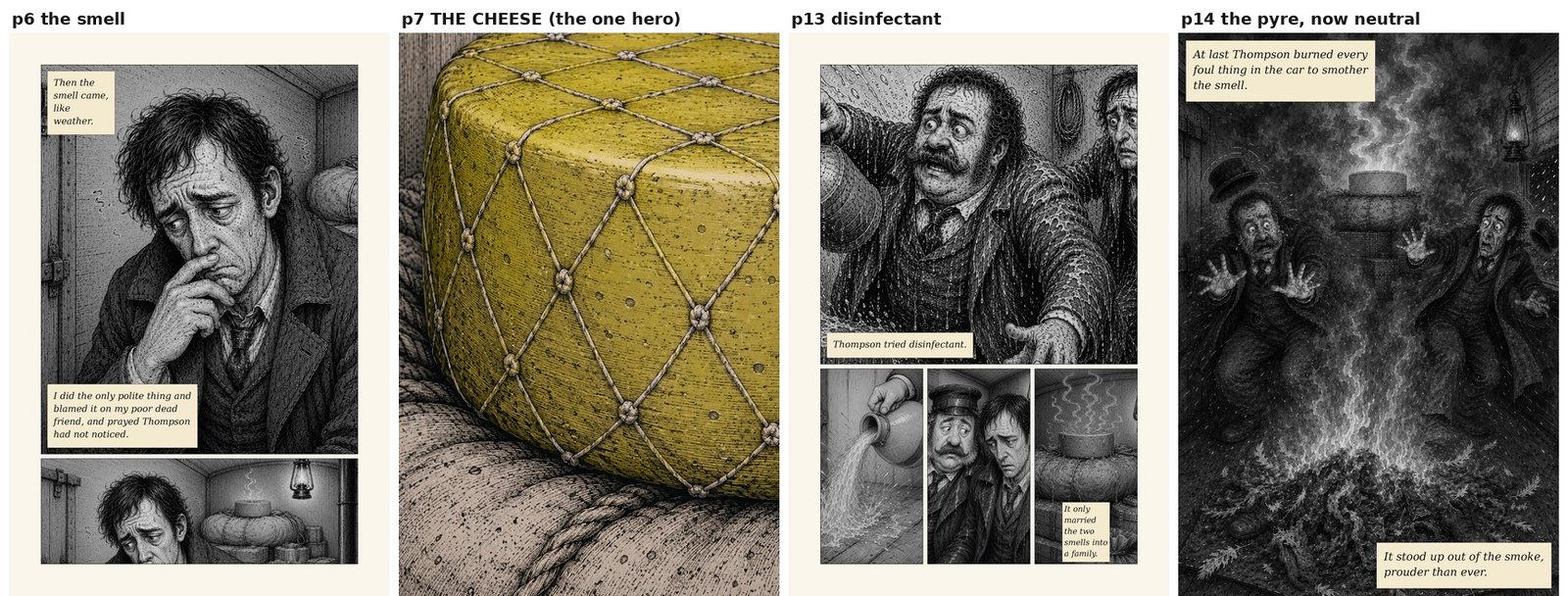
It was carbolic acid. He had a carboy of it. He sprinkled it all around everywhere; in fact he drenched everything with it, rifle-box, cheese and all. Then we sat down, feeling pretty hopeful. But it wasn’t for long. You see the two perfumes began to mix, and then—well, pretty soon we made a break for the door; and out there Thompson swabbed his face with his bandanna and said in a kind of disheartened way,
“It ain’t no use. We can’t buck agin him. He just utilizes everything we put up to modify him with, and gives it his own flavor and plays it back on us. Why, Cap., don’t you know, it’s as much as a hundred times worse in there now than it was when he first got a-going. I never did see one of ’em warm up to his work so, and take such a dumnation interest in it. No, Sir, I never did, as long as I’ve ben on the road; and I’ve carried a many a one of ’em, as I was telling you.”
We went in again after we were frozen pretty stiff; but my, we couldn’t stay in, now. So we just waltzed back and forth, freezing, and thawing, and stifling, by turns. In about an hour we stopped at another station; and as we left it Thompson came in with a bag, and said,—
“Cap., I’m a-going to chance him once more,—just this once; and if we don’t fetch him this time, the thing for us to do, is to just throw up the sponge and withdraw from the canvass. That’s the way I put it up.” He had brought a lot of chicken feathers, and dried apples, and leaf tobacco, and rags, and old shoes, and sulphur, and asafoetida, and one thing or another; and he, piled them on a breadth of sheet iron in the middle of the floor, and set fire to them.
When they got well started, I couldn’t see, myself, how even the corpse could stand it. All that went before was just simply poetry to that smell,—but mind you, the original smell stood up out of it just as sublime as ever,—fact is, these other smells just seemed to give it a better hold; and my, how rich it was! I didn’t make these reflections there—there wasn’t time—made them on the platform. And breaking for the platform, Thompson got suffocated and fell; and before I got him dragged out, which I did by the collar, I was mighty near gone myself. When we revived, Thompson said dejectedly,—
“We got to stay out here, Cap. We got to do it. They ain’t no other way. The Governor wants to travel alone, and he’s fixed it so he can outvote us.”
And presently he added,
“And don’t you know, we’re pisoned. It’s our last trip, you can make up your mind to it. Typhoid fever is what’s going to come of this. I feel it acoming right now. Yes, sir, we’re elected, just as sure as you’re born.”
We were taken from the platform an hour later, frozen and insensible, at the next station, and I went straight off into a virulent fever, and never knew anything again for three weeks. I found out, then, that I had spent that awful night with a harmless box of rifles and a lot of innocent cheese; but the news was too late to save me; imagination had done its work, and my health was permanently shattered; neither Bermuda nor any other land can ever bring it back to me. This is my last trip; I am on my way home to die.
The Invalid’s Story, Told Once More
A modern retelling by R. M. Hume
I look about sixty. I am forty-one. I ought to tell you that before anything else, because the rest is going to sound like nothing, and nothing is exactly what did this to me. Two years ago I was strong. Then I spent one winter night on a train with a box of rifles and a piece of cheese, and here I am, a draft under a door.
It started with bad news. I got home to Cleveland after dark, snow coming down sideways, and heard that my oldest friend had died. His last wish was that I bring him home to his people up in Wisconsin. No time for any of that. I went straight to the station, found the long pine box waiting just as they told me, tacked the card on it, my friend’s name and the town in Wisconsin, watched them load it, and ducked into the lunch room for a sandwich and some cigars.
Here is the part I did not know, and you should. While I was buying cigars, two boxes got mixed up. Mine went one way. The other one, a crate of rifles somebody was shipping to a gun company down in Peoria, came my way. I tacked my friend’s name onto a box of guns and never suspected a thing. Keep that in your pocket. I wish I’d had it in mine.
The conductor hollered, I climbed into the express car, and I found a seat on a stack of pails. The expressman was already working, a solid, cheerful man of about fifty named Thompson, the kind who hums while he ties things down. Right as we pulled out, a stranger hopped aboard, set a wrapped package on the end of my box, and hopped off. I did not think anything of it. I had never met the thing in the package. Its name, I would learn much later, was cheese. Limburger cheese.
Thompson got us cozy. He shut the doors, bolted them, dropped the window tight, and built a serious fire in the stove, humming a hymn the whole time, butchering every third note. And somewhere in there a smell arrived. I will only say it arrived like weather. I blamed my poor friend, of course, and felt terrible for thinking it, and worse for the fact that Thompson would surely notice.
Thompson noticed.
The humming quit. He stood, took a long look at the box, came back, sat down heavy, and said, kind as anything, “Friend of yours?” I said yes. He nodded. “He’s pretty ripe, ain’t he.” And then, because Thompson was a philosopher, he settled in and gave me his views on how we all must go, breaking off now and then to put his nose out a crack in the window, which I would do right after him, the two of us taking turns at that crack, grabbing a clean breath while we could.
What I remember most is how Thompson kept promoting my friend. The worse the smell got, the bigger the title. Early on he was just a friend. An hour in, the Colonel. Then the General. By the worst of it he was the Governor, because by then he plainly ran that car, and nothing we tried could out-argue him. “He wants to travel alone,” Thompson said, “and he’s fixed so he can outvote us.”
We tried things. We tried cigars, which only seemed to give the Governor ambition. We tried shoving the box to the far end of the car, and Thompson slipped and got a closer acquaintance with it than he wanted and made for the door announcing that he was dying and needed the road. We tried a jug of disinfectant, splashed over everything, and before long the two smells had a family. Last, Thompson gathered up every foul thing on the train, feathers and old shoes and a resin the old folks called by a worse name, piled them on a sheet of iron, and lit them. That was the one that nearly finished us both, and through all of it, he told me later, the original smell stood up out of the smoke as proud as ever, just glad for the company.
So we gave up and stood out on the platform in the storm, freezing on purpose, going in only when the cold beat the smell, which was not often. Thompson had made his diagnosis by then. “We’re pisoned,” he said. “It’s our last trip. Fever’s coming. You can feel it.’’ They pulled us off the platform at the next station, frozen stiff and out cold, and I went straight into three weeks of fever and knew nothing of the world.
When I came back to it, they told me the truth. A box of rifles. A piece of cheese. Nothing in that car had ever been anything but harmless. And it did not matter one bit, because my imagination had already done the work my body could not undo.
A man can be ruined by a fact that was never true, if he believes it hard enough on a cold enough night.
I suppose this is my last trip. I am on my way home to die.
How Twain Said to Tell It
In the same slim volume, Twain opens with a lecture called How to Tell a Story, and it reads like the instruction sheet for the farce that follows. He splits all jokes into two piles. The comic and witty story rides on its matter, on the joke itself, and anyone can tell it. The humorous story lives in the manner of the telling, in a straight face held just so, and that, he says, is a high and delicate art only a master can manage. Call them the easy kind and the hard kind. Everything in this edition is about the hard kind.
His central rule is the one this narrator follows to the letter. Tell it gravely, and never let the reader see you find any of it funny. The narrator does exactly that. Shut in the sealed car, sure he is riding with the body of a dead friend, he reports the whole ghastly night in dead earnest and never winks once. That straight face is the joke.
The narrator keeps that straight face over the whole story. Twain’s four specific tricks, though, are easiest to catch in Thompson, the expressman riding beside him. Watch him string absurdities together as if he never notices they are absurd, promoting the cheese up the ranks as the smell worsens, from the Colonel to the General to the Commodore to the Governor, and never once smiling at his own joke. Watch him slur the point, dropping the worst of it flat and offhand instead of leaning on it, studying the crate and saying only, ‘He’s pretty ripe, ain’t he!’ A studied remark falls as if he were merely thinking aloud, the mock-solemn ‘we’ve all got to go, they ain’t no getting around it,’ spoken like a man talking himself into peace. And the pause does its work in the clipped exchange, where the narrator says the body has been dead two or three days and Thompson waits a beat before topping him: ‘Two or three years, you mean.’ Read his lines slowly and all four are there.
There is one line in the lecture that could serve as the motto for this entire edition. Twain says the humorous story is fine art that only a master can manage, and then adds, flatly, that the other kind takes no art at all. He meant the comic story, the kind that shouts its joke and italicizes the point. We decided to take him at his word. So we pointed a language model at the hardest kind of story he knew, to see what happens. Read the story, then read his rules, and judge for yourself whether the trick survives the trip, and whether the newest teller can keep the straight face the joke depends on.
The humorous story is strictly a work of art, high and delicate art, and only an artist can tell it; but no art is necessary in telling the comic and the witty story. So said Twain. The humorous story is the hard one, the deadpan only a master can hold, and this edition hands it to a language model anyway.
A Note on This Edition
Twain’s words sit here as he wrote them, untouched. The notes and the modern retelling are new work by R. M. Hume, written with the help of AI. Hume chose the story, wrote the notes and the retelling, and made the final calls about what stayed and what changed.
This is the second story in Mark Twain in an AI World, and it carries the same test the whole project runs. The first, the Jumping Frog, asked whether a language model could hear a joke across four languages. This one narrows the question to a single straight face. Twain built the humor entirely on a teller who never lets on, and he told us plainly that the mechanical kind of joke is the easy kind. So the retelling walks straight into that dare.
A fully illustrated graphic novel of this story is on the way, drawn in the same style as the Jumping Frog. This page is the reading edition and the place to start. Watch the man in the sealed car keep his composure over a wheel of cheese, and decide for yourself whether the newest teller in the line keeps his.
More on Twain’s method: How Twain Said to Tell It → · The Rulebook Twain Hid in an Insult →
Stay in the loop
New Twain editions and the occasional essay, straight to your inbox. Just that, nothing else.
You are joining updates from Mark Twain in an AI World. Just this, nothing else, unsubscribe anytime.