Examination Evening
From The Adventures of Tom Sawyer, 1876 · In the public domain
Annotations and modern retelling © 2026 R. M. Hume
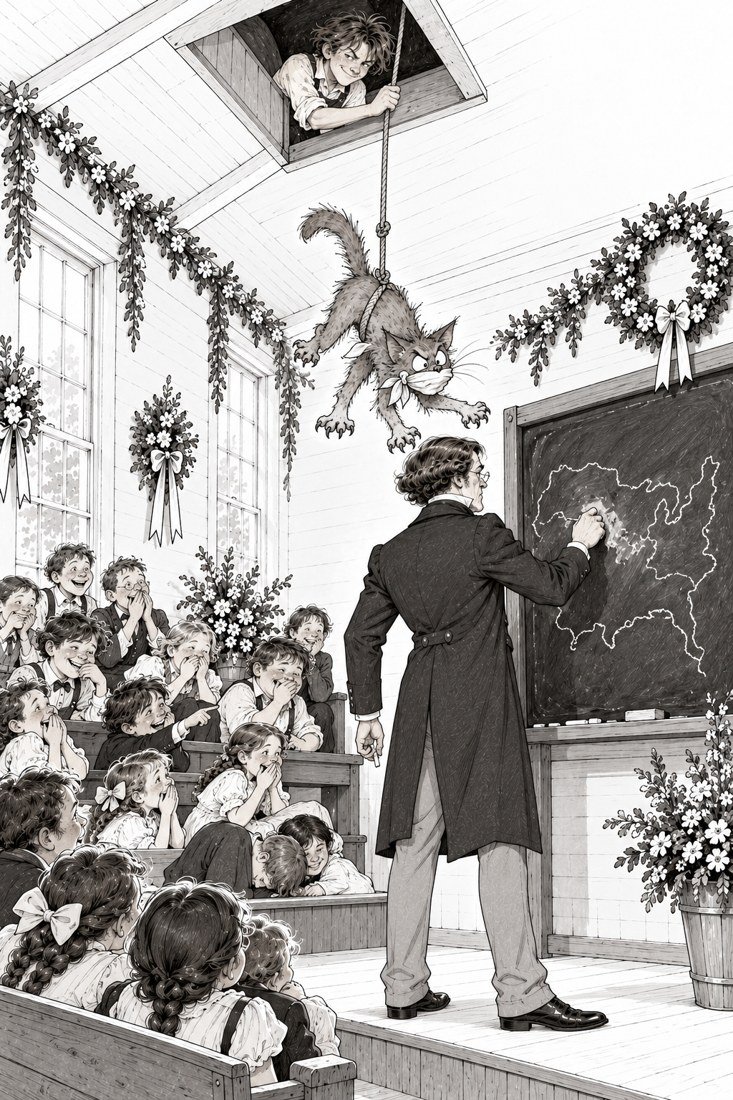
Before you begin, know that the illustrated retelling is largely a pantomime. The schoolmaster bends over his map with his back to the room, the giggling climbs behind him, and a cat comes down from the ceiling on a string. The comedy is all in what the master does not see.
Mr. Dobbins ran his school by the cane, and he wanted a grand showing on examination night, with the whole town watching. The small boys had spent the term in terror and their spare hours plotting, and none of it had come to anything. What finally did was simple. Dobbins wore a wig over a bald head he was vain about hiding, and the boys brought in the sign-painter’s apprentice, who had a grudge of his own, to work the string.
Watch the two halves fit together. The front of the evening is the town performing for itself, the stiff little reciters, the melodramatic young ladies, Tom freezing mid-speech. The back of it is the quiet machine in the ceiling. The second half pays off the first.
Examination Evening
As Mark Twain wrote it, 1876
Vacation was approaching. The schoolmaster, always severe, grew severer and more exacting than ever, for he wanted the school to make a good showing on “Examination” day. His rod and his ferule were seldom idle now—at least among the smaller pupils. Only the biggest boys, and young ladies of eighteen and twenty, escaped lashing. Mr. Dobbins’ lashings were very vigorous ones, too; for although he carried, under his wig, a perfectly bald and shiny head, he had only reached middle age, and there was no sign of feebleness in his muscle. As the great day approached, all the tyranny that was in him came to the surface; he seemed to take a vindictive pleasure in punishing the least shortcomings. The consequence was, that the smaller boys spent their days in terror and suffering and their nights in plotting revenge. They threw away no opportunity to do the master a mischief. But he kept ahead all the time. The retribution that followed every vengeful success was so sweeping and majestic that the boys always retired from the field badly worsted. At last they conspired together and hit upon a plan that promised a dazzling victory. They swore in the signpainter’s boy, told him the scheme, and asked his help. He had his own reasons for being delighted, for the master boarded in his father’s family and had given the boy ample cause to hate him. The master’s wife would go on a visit to the country in a few days, and there would be nothing to interfere with the plan; the master always prepared himself for great occasions by getting pretty well fuddled, and the signpainter’s boy said that when the dominie had reached the proper condition on Examination Evening he would “manage the thing” while he napped in his chair; then he would have him awakened at the right time and hurried away to school.
In the fulness of time the interesting occasion arrived. At eight in the evening the schoolhouse was brilliantly lighted, and adorned with wreaths and festoons of foliage and flowers. The master sat throned in his great chair upon a raised platform, with his blackboard behind him. He was looking tolerably mellow. Three rows of benches on each side and six rows in front of him were occupied by the dignitaries of the town and by the parents of the pupils. To his left, back of the rows of citizens, was a spacious temporary platform upon which were seated the scholars who were to take part in the exercises of the evening; rows of small boys, washed and dressed to an intolerable state of discomfort; rows of gawky big boys; snowbanks of girls and young ladies clad in lawn and muslin and conspicuously conscious of their bare arms, their grandmothers’ ancient trinkets, their bits of pink and blue ribbon and the flowers in their hair. All the rest of the house was filled with non-participating scholars.
The exercises began. A very little boy stood up and sheepishly recited, “You’d scarce expect one of my age to speak in public on the stage,” etc.—accompanying himself with the painfully exact and spasmodic gestures which a machine might have used—supposing the machine to be a trifle out of order. But he got through safely, though cruelly scared, and got a fine round of applause when he made his manufactured bow and retired.
A little shamefaced girl lisped, “Mary had a little lamb,” etc., performed a compassion-inspiring curtsy, got her meed of applause, and sat down flushed and happy.
Tom Sawyer stepped forward with conceited confidence and soared into the unquenchable and indestructible “Give me liberty or give me death” speech, with fine fury and frantic gesticulation, and broke down in the middle of it. A ghastly stage-fright seized him, his legs quaked under him and he was like to choke. True, he had the manifest sympathy of the house but he had the house’s silence, too, which was even worse than its sympathy. The master frowned, and this completed the disaster. Tom struggled awhile and then retired, utterly defeated. There was a weak attempt at applause, but it died early.
“The Boy Stood on the Burning Deck” followed; also “The Assyrian Came Down,” and other declamatory gems. Then there were reading exercises, and a spelling fight. The meagre Latin class recited with honor. The prime feature of the evening was in order, now—original “compositions” by the young ladies. Each in her turn stepped forward to the edge of the platform, cleared her throat, held up her manuscript (tied with dainty ribbon), and proceeded to read, with labored attention to “expression” and punctuation. The themes were the same that had been illuminated upon similar occasions by their mothers before them, their grandmothers, and doubtless all their ancestors in the female line clear back to the Crusades. “Friendship” was one; “Memories of Other Days”; “Religion in History”; “Dream Land”; “The Advantages of Culture”; “Forms of Political Government Compared and Contrasted”; “Melancholy”; “Filial Love”; “Heart Longings,” etc., etc.
A prevalent feature in these compositions was a nursed and petted melancholy; another was a wasteful and opulent gush of “fine language”; another was a tendency to lug in by the ears particularly prized words and phrases until they were worn entirely out; and a peculiarity that conspicuously marked and marred them was the inveterate and intolerable sermon that wagged its crippled tail at the end of each and every one of them. No matter what the subject might be, a brainracking effort was made to squirm it into some aspect or other that the moral and religious mind could contemplate with edification. The glaring insincerity of these sermons was not sufficient to compass the banishment of the fashion from the schools, and it is not sufficient today; it never will be sufficient while the world stands, perhaps. There is no school in all our land where the young ladies do not feel obliged to close their compositions with a sermon; and you will find that the sermon of the most frivolous and the least religious girl in the school is always the longest and the most relentlessly pious. But enough of this. Homely truth is unpalatable.
Let us return to the “Examination.” The first composition that was read was one entitled “Is this, then, Life?” Perhaps the reader can endure an extract from it:
“In the common walks of life, with what delightful emotions does the youthful mind look forward to some anticipated scene of festivity! Imagination is busy sketching rose-tinted pictures of joy. In fancy, the voluptuous votary of fashion sees herself amid the festive throng, ‘the observed of all observers.’ Her graceful form, arrayed in snowy robes, is whirling through the mazes of the joyous dance; her eye is brightest, her step is lightest in the gay assembly.
“In such delicious fancies time quickly glides by, and the welcome hour arrives for her entrance into the Elysian world, of which she has had such bright dreams. How fairy-like does everything appear to her enchanted vision! Each new scene is more charming than the last. But after a while she finds that beneath this goodly exterior, all is vanity, the flattery which once charmed her soul, now grates harshly upon her ear; the ballroom has lost its charms; and with wasted health and imbittered heart, she turns away with the conviction that earthly pleasures cannot satisfy the longings of the soul!”
And so forth and so on. There was a buzz of gratification from time to time during the reading, accompanied by whispered ejaculations of “How sweet!” “How eloquent!” “So true!” etc., and after the thing had closed with a peculiarly afflicting sermon the applause was enthusiastic.
Then arose a slim, melancholy girl, whose face had the “interesting” paleness that comes of pills and indigestion, and read a “poem.” Two stanzas of it will do:
“A MISSOURI MAIDEN’S FAREWELL TO ALABAMA
“Alabama, goodbye! I love thee well! But yet for a while do I leave thee now! Sad, yes, sad thoughts of thee my heart doth swell, And burning recollections throng my brow! For I have wandered through thy flowery woods; Have roamed and read near Tallapoosa’s stream; Have listened to Tallassee’s warring floods, And wooed on Coosa’s side Aurora’s beam.
“Yet shame I not to bear an o’erfull heart, Nor blush to turn behind my tearful eyes; ’Tis from no stranger land I now must part, ’Tis to no strangers left I yield these sighs. Welcome and home were mine within this State, Whose vales I leave—whose spires fade fast from me And cold must be mine eyes, and heart, and tête, When, dear Alabama! they turn cold on thee!”
There were very few there who knew what “tête” meant, but the poem was very satisfactory, nevertheless.
Next appeared a dark-complexioned, black-eyed, black-haired young lady, who paused an impressive moment, assumed a tragic expression, and began to read in a measured, solemn tone:
A VISION
Dark and tempestuous was night. Around the throne on high not a single star quivered; but the deep intonations of the heavy thunder constantly vibrated upon the ear; whilst the terrific lightning revelled in angry mood through the cloudy chambers of heaven, seeming to scorn the power exerted over its terror by the illustrious Franklin! Even the boisterous winds unanimously came forth from their mystic homes, and blustered about as if to enhance by their aid the wildness of the scene.
At such a time, so dark, so dreary, for human sympathy my very spirit sighed; but instead thereof,
‘My dearest friend, my counsellor, my comforter and guide— My joy in grief, my second bliss in joy,’ came to my side.
She moved like one of those bright beings pictured in the sunny walks of fancy’s Eden by the romantic and young, a queen of beauty unadorned save by her own transcendent loveliness. So soft was her step, it failed to make even a sound, and but for the magical thrill imparted by her genial touch, as other unobtrusive beauties, she would have glided away unperceived—unsought. A strange sadness rested upon her features, like icy tears upon the robe of December, as she pointed to the contending elements without, and bade me contemplate the two beings presented.
This nightmare occupied some ten pages of manuscript and wound up with a sermon so destructive of all hope to non-Presbyterians that it took the first prize. This composition was considered to be the very finest effort of the evening. The mayor of the village, in delivering the prize to the author of it, made a warm speech in which he said that it was by far the most “eloquent” thing he had ever listened to, and that Daniel Webster himself might well be proud of it.
It may be remarked, in passing, that the number of compositions in which the word “beauteous” was over-fondled, and human experience referred to as “life’s page,” was up to the usual average.
Now the master, mellow almost to the verge of geniality, put his chair aside, turned his back to the audience, and began to draw a map of America on the blackboard, to exercise the geography class upon. But he made a sad business of it with his unsteady hand, and a smothered titter rippled over the house. He knew what the matter was, and set himself to right it. He sponged out lines and remade them; but he only distorted them more than ever, and the tittering was more pronounced. He threw his entire attention upon his work, now, as if determined not to be put down by the mirth. He felt that all eyes were fastened upon him; he imagined he was succeeding, and yet the tittering continued; it even manifestly increased. And well it might. There was a garret above, pierced with a scuttle over his head; and down through this scuttle came a cat, suspended around the haunches by a string; she had a rag tied about her head and jaws to keep her from mewing; as she slowly descended she curved upward and clawed at the string, she swung downward and clawed at the intangible air. The tittering rose higher and higher—the cat was within six inches of the absorbed teacher’s head—down, down, a little lower, and she grabbed his wig with her desperate claws, clung to it, and was snatched up into the garret in an instant with her trophy still in her possession! And how the light did blaze abroad from the master’s bald pate—for the signpainter’s boy had gilded it!
That broke up the meeting. The boys were avenged. Vacation had come.
[*] NOTE:—The pretended “compositions” quoted in this chapter are taken without alteration from a volume entitled “Prose and Poetry, by a Western Lady”—but they are exactly and precisely after the schoolgirl pattern, and hence are much happier than any mere imitations could be.
Examination Evening, Told Once More
A modern retelling by R. M. Hume
Summer vacation was almost there, which meant Mr. Dobbins the schoolmaster was at his worst. He was always a hard man, but with Examination day coming he wanted the school to make a fine showing, and his cane and his ruler were never idle. The small boys spent their days in terror and their nights plotting revenge, and they never missed a chance to do him a mischief. It did them no good. He stayed a step ahead every time, and the punishment that came down afterward was so complete that the boys always limped away beaten.
Dobbins had one tender spot. Under his wig he carried a perfectly bald and shiny head, and he was vain about hiding it. So at last the boys made their plan around it, and they brought in the sign-painter’s boy to help. He had his own reasons to join. The master boarded with his family and had given the boy plenty of cause to hate him. The master’s wife was going away to the country for a few days, which left the field clear, and everyone knew that Dobbins always steadied himself for a big occasion by getting quietly and thoroughly drunk. The sign-painter’s boy promised that when the master had drunk enough and dozed off in his chair, he would see to the rest.
The evening came, and the schoolhouse was lit up bright and hung with wreaths and flowers. The master sat throned in his great chair on a platform, looking tolerably mellow already, with the blackboard behind him. The front rows were packed with the important people of the town and the parents of the pupils, and off to the side sat the scholars who were to perform, scrubbed and dressed into perfect misery.
The performing began. A very small boy stood up and piped out “You’d scarcely expect one of my age to speak in public on the stage,” jerking through the gestures like a machine with a loose part, and got his applause and sat down. A little girl lisped “Mary had a little lamb,” curtsied, and got hers. Then Tom Sawyer marched up full of confidence and launched into “Give me liberty or give me death” with tremendous fire, got about halfway, and froze. A terrible stage fright took him by the legs, the room went silent, the master frowned, and that finished him. Tom struggled a moment and then retired, beaten to nothing.
After the recitations came the part of the evening everyone pretended to admire most, the original compositions by the young ladies. One after another they stepped to the edge of the platform, cleared their throats, and read out pages of sighing, flowery sentences. One girl paused for an impressive moment, put on a tragic expression, and launched into a piece she called “A Vision”: “Dark and tempestuous was night. Around the throne on high not a single star quivered; but the deep intonations of the heavy thunder constantly vibrated upon the ear.” And no matter what the subject had been, every one of them wound up with a solemn little sermon pinned to the end, which the audience received with murmurs of “How sweet” and “How eloquent” and warm applause.
Then it was time for the geography lesson, and the master, mellow now almost to the point of good humor, turned his back on the room and set about drawing a map of America on the blackboard for the class to study. His hand was unsteady, though, and he made a sad business of it, and a smothered giggle started up around the room. He knew what the trouble was and bent to fix it, wiping out his crooked lines and drawing them again only to make them worse, and the giggling got louder. He threw his whole attention into the work, determined not to be laughed down. He felt every eye on his back and kept drawing, certain he was winning, while the tittering climbed higher and higher.
And it had good reason to climb. Over his head there was a trap-door in the garret ceiling, and down through it, slowly, came a cat. She was tied around the middle with a cord, a rag over her jaws to keep her quiet, and as she sank she clawed at the air and curled and twisted on the string. Lower and lower she came, a few inches above the busy master’s head, straining downward, until she got a grip. Her desperate claws caught hold of his wig, she clung to it, and in the same instant she was jerked back up into the garret with her prize. And the light fairly blazed off the master’s bald head, because the sign-painter’s boy had gilded it.
That broke up the meeting. The boys were avenged. Vacation had come.
What Twain Was Doing
Twain published this in 1876, in the twenty-first chapter of The Adventures of Tom Sawyer. The scene is built in two movements. The first sets up the examination as a solemn public performance, and the second punctures it. Twain lets the melodrama run, from the tiny boy jerking through his gestures to the young lady reading her flowery ‘Vision,’ and trusts the reader to hear how overblown it all is without being told.
Then he turns the master around. Dobbins, mellow with drink and his back to the room, sets about drawing a map on the blackboard and makes a bad business of it, and the giggling starts. Here Twain runs a long stretch of pure dramatic irony. The room knows what is coming and the master does not, and the tension is simply how long the cat can be made to dangle.
The payoff is slapstick, but it is aimed. The cat takes the wig, the gilded scalp blazes out, and the tyrant of the first half is undone in front of the very town he wanted to impress. The revenge is public, which is the whole point. Twain ends on the boys, not the master. The account is settled, and vacation has come.
A Note on This Edition
Twain’s text is reproduced verbatim from the 1876 publication, including his own closing footnote about the compositions. Nothing has been rewritten or modernized. The only additions within the passage are the annotations, which explain words, references, and historical context without changing the underlying text. The retelling below is the only rewritten version. The retelling and these notes were written by R. M. Hume with the help of AI.
This edition presents the whole of the twenty-first chapter of The Adventures of Tom Sawyer, which is the examination-evening scene entire, followed by a modern retelling of it. The passage runs from the master’s pre-vacation tyranny through the exhibition, Tom’s freeze, the parody compositions, the map, the cat, and the gilded head, to ‘the boys were avenged.’ The retelling compresses the long schoolgirl compositions, which Twain quotes at length here; the word-for-word text keeps them in full.
This is the fifth of the Tom Sawyer pieces in Mark Twain in an AI World, alongside Whitewashing the Fence, The Pinchbug and the Poodle, The Pain-Killer and the Cat, and The Sunday-School Prize. As in the rest of the series, Twain’s own text sits word for word beside a plain modern retelling, so you can see exactly what was changed and what was not.
More on Twain’s method:
How Twain Said to Tell It →
·
The Rulebook Twain Hid in an Insult →