The Tick in School
From The Adventures of Tom Sawyer, 1876 · In the public domain
Annotations and modern retelling © 2026 R. M. Hume
Before you begin, know that almost nothing in this scene matters, and that the two boys treat it as though everything does. A bored afternoon, a tick out of a boy’s pocket, a slate with a line drawn down the middle, and a set of rules invented on the spot. The comedy is the gap between how small the thing is and how seriously the boys take it.
Tom and Joe Harper are best friends, which in Twain’s phrase means sworn friends all week and sworn enemies every Saturday. Watch the game turn. It starts as two boys sharing a secret against a dull classroom, and it ends as a border war over who owns a bug, with the friendship cracking in real time over nothing at all.
And watch the one thing the boys forget. While they bend closer and closer over the slate, the master they stopped thinking about has been standing behind them a good long while, and he is in no hurry.
The Tick in School
As Mark Twain wrote it, 1876
The harder Tom tried to fasten his mind on his book, the more his ideas wandered. So at last, with a sigh and a yawn, he gave it up. It seemed to him that the noon recess would never come. The air was utterly dead. There was not a breath stirring. It was the sleepiest of sleepy days. The drowsing murmur of the five and twenty studying scholars soothed the soul like the spell that is in the murmur of bees. Away off in the flaming sunshine, Cardiff Hill lifted its soft green sides through a shimmering veil of heat, tinted with the purple of distance; a few birds floated on lazy wing high in the air; no other living thing was visible but some cows, and they were asleep. Tom’s heart ached to be free, or else to have something of interest to do to pass the dreary time. His hand wandered into his pocket and his face lit up with a glow of gratitude that was prayer, though he did not know it. Then furtively the percussion-cap box came out. He released the tick and put him on the long flat desk. The creature probably glowed with a gratitude that amounted to prayer, too, at this moment, but it was premature: for when he started thankfully to travel off, Tom turned him aside with a pin and made him take a new direction.
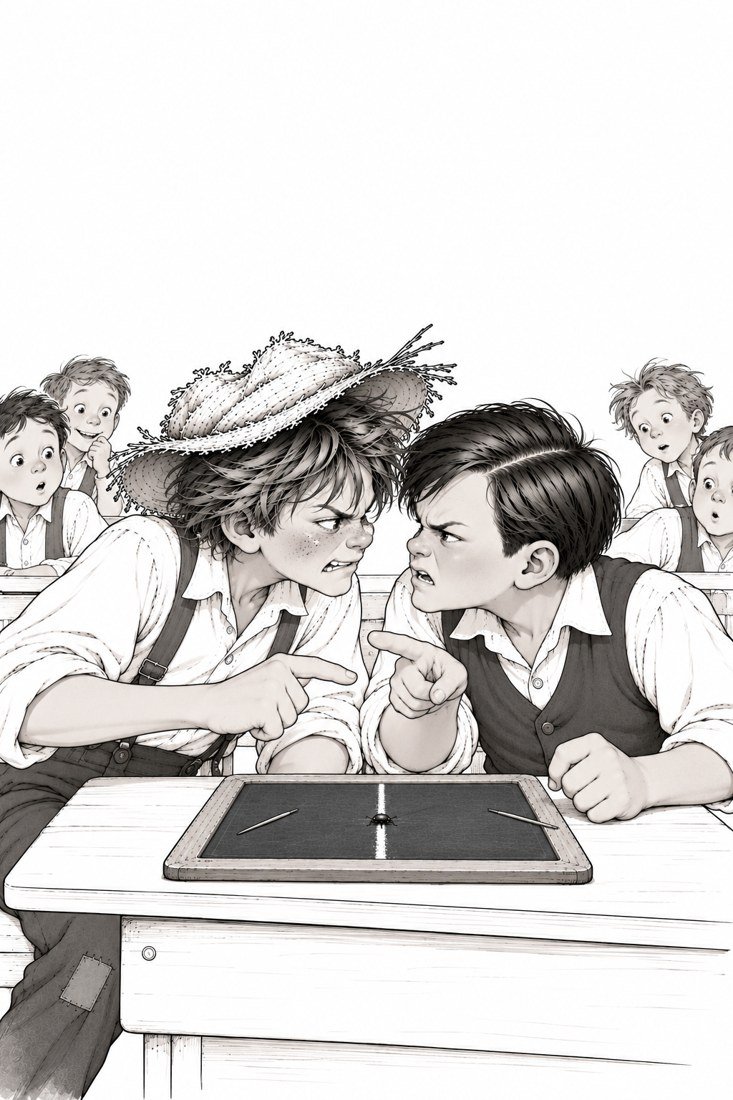
Tom’s bosom friend sat next him, suffering just as Tom had been, and now he was deeply and gratefully interested in this entertainment in an instant. This bosom friend was Joe Harper. The two boys were sworn friends all the week, and embattled enemies on Saturdays. Joe took a pin out of his lapel and began to assist in exercising the prisoner. The sport grew in interest momently. Soon Tom said that they were interfering with each other, and neither getting the fullest benefit of the tick. So he put Joe’s slate on the desk and drew a line down the middle of it from top to bottom.
“Now,” said he, “as long as he is on your side you can stir him up and I’ll let him alone; but if you let him get away and get on my side, you’re to leave him alone as long as I can keep him from crossing over.”
“All right, go ahead; start him up.”
The tick escaped from Tom, presently, and crossed the equator. Joe harassed him awhile, and then he got away and crossed back again. This change of base occurred often. While one boy was worrying the tick with absorbing interest, the other would look on with interest as strong, the two heads bowed together over the slate, and the two souls dead to all things else. At last luck seemed to settle and abide with Joe. The tick tried this, that, and the other course, and got as excited and as anxious as the boys themselves, but time and again just as he would have victory in his very grasp, so to speak, and Tom’s fingers would be twitching to begin, Joe’s pin would deftly head him off, and keep possession. At last Tom could stand it no longer. The temptation was too strong. So he reached out and lent a hand with his pin. Joe was angry in a moment. Said he:
“Tom, you let him alone.”
“I only just want to stir him up a little, Joe.”
“No, sir, it ain’t fair; you just let him alone.”
“Blame it, I ain’t going to stir him much.”
“Let him alone, I tell you.”
“I won’t!”
“You shall—he’s on my side of the line.”
“Look here, Joe Harper, whose is that tick?”
“I don’t care whose tick he is—he’s on my side of the line, and you sha’n’t touch him.”
“Well, I’ll just bet I will, though. He’s my tick and I’ll do what I blame please with him, or die!”
A tremendous whack came down on Tom’s shoulders, and its duplicate on Joe’s; and for the space of two minutes the dust continued to fly from the two jackets and the whole school to enjoy it. The boys had been too absorbed to notice the hush that had stolen upon the school awhile before when the master came tiptoeing down the room and stood over them. He had contemplated a good part of the performance before he contributed his bit of variety to it.
The Tick in School, Told Once More
A modern retelling by R. M. Hume
The harder Tom tried to keep his mind on his book, the more it wandered off, until at last he gave up with a sigh and a yawn. Noon recess felt like it would never come. The air was dead still, the hottest and sleepiest kind of afternoon, and the low drone of twenty-five children mumbling their lessons settled over the room like the hum of bees. Off through the window Cardiff Hill stood green and shimmering in the heat, a few birds drifting overhead, and the only other living things in sight were some cows, and they were asleep. Tom ached to be out of there, or at least to have something to do.
Then his hand found his pocket, and his face lit up. Out came the little percussion-cap box, and out of that came the tick. He set it on the long flat desk, and when the tick started gratefully off toward freedom, Tom headed it off with a pin and turned it the other way.
His best friend sat right next to him, suffering through the same dull afternoon, and he brightened at the entertainment in a second. This was Joe Harper. The two of them were sworn friends all week and sworn enemies every Saturday. Joe took a pin out of his lapel and joined in, and the game got better by the minute. Pretty soon Tom said they were getting in each other’s way and neither of them was getting the full good of the tick. So he laid Joe’s slate on the desk and drew a line straight down the middle, top to bottom.
“Now,” he said, “as long as he’s on your side you can stir him up and I’ll leave him be. But if you let him get across onto my side, you leave him alone as long as I can keep him from crossing back.”
“All right. Go ahead, start him up.”
The tick got away from Tom and crossed the line, and Joe worked him for a while, and then he slipped back across again. Back and forth it went. While one boy chased the tick the other watched just as hard, the two heads bowed together over the slate, the two of them dead to everything else in the world. After a bit the luck settled with Joe. The tick tried this way and that, getting as worked up as the boys were, but every time it looked ready to cross, just as Tom’s fingers were itching to start, Joe’s pin would turn it back. At last Tom could not stand it. He reached over and gave it a nudge with his own pin. Joe was angry in a second.
“Tom, you let him alone.”
“I only just want to stir him up a little, Joe.”
“No, sir, it ain’t fair. You let him alone.”
“Shucks, I ain’t going to stir him much.”
“Let him alone, I tell you.”
“I won’t!”
“You’ve got to. He’s on my side of the line.”
“Look here, Joe Harper, whose tick is that?”
“I don’t care whose tick he is. He’s on my side of the line, and you shan’t touch him.”
“Well, I’ll just bet I will. He’s my tick and I’ll do what I please with him, or die!”
What came down next was a tremendous whack across Tom’s shoulders, and its twin across Joe’s, and for a solid two minutes the dust flew off both jackets while the whole school enjoyed the show. The boys had been so deep in the tick that they never noticed the room go quiet, or the master come tiptoeing down the aisle to stand over them. He had watched a good long stretch of the performance before he added a little something of his own.
What Twain Was Doing
Twain published this in 1876, in the seventh chapter of The Adventures of Tom Sawyer. The whole scene is two boys and an insect, and Twain plays it with a patient, straight face. He spends his first beats on pure boredom, the dead air, the drone of the room, a boy with nothing to do, so that the arrival of a tick lands like rescue. The smallness is the joke, and he never winks at it.
Then he builds a game. The boys lay down an equator across the slate and a code of law to go with it, each boy sovereign on his own side, and for a while they cooperate like diplomats. Twain lets the reader feel the pleasure of it before he breaks it. The turn is quiet. Joe’s luck holds, Tom cannot stand being shut out, his pin strays across the line, and in a sentence the alliance becomes a quarrel.
The quarrel is where Twain aims. Two boys who were a single absorbed creature a moment ago are suddenly squared up over the ownership of a bug, swearing they will do as they please with it or die, and they have forgotten the room exists. That is the setup for the one thing they cannot see coming. The master has been watching the entire time, and the payoff is a whack apiece and the dust flying off two jackets while the school enjoys the show. Twain ends on the boys, caught, which is the whole point.
A Note on This Edition
Twain’s text is reproduced verbatim from the 1876 publication. Nothing has been rewritten or modernized. The only additions within the passage are the annotations, which explain words, references, and historical context without changing the underlying text. The retelling below is the only rewritten version. The retelling and these notes were written by R. M. Hume with the help of AI.
This edition presents the schoolroom tick duel that opens the seventh chapter of The Adventures of Tom Sawyer, word for word, followed by a modern retelling of it. The passage runs from the drowsy afternoon and the freeing of the tick through the dividing line, the duel, the quarrel over whose tick it is, and the master’s double whack. The Becky Thatcher courtship that follows later in the same chapter is a separate scene and is not included here.
This is one of the Tom Sawyer pieces in Mark Twain in an AI World, alongside Whitewashing the Fence, The Pinchbug and the Poodle, The Pain-Killer and the Cat, The Sunday-School Prize, and Examination Evening. As in the rest of the series, Twain’s own text sits word for word beside a plain modern retelling, so you can see exactly what was changed and what was not.
More on Twain’s method:
How Twain Said to Tell It →
·
The Rulebook Twain Hid in an Insult →