Tom and Becky, the First Courtship
From The Adventures of Tom Sawyer, 1876 · In the public domain
Annotations and modern retelling © 2026 R. M. Hume
Before you begin, know that this is Tom Sawyer in love, which means Tom Sawyer at his most absurd and his most sincere at the same time. He has never spoken to this girl. He does not know her name. And within a morning he has engineered a whipping to get a seat beside her, courted her with a drawing of a house, and gotten himself engaged.
Watch how seriously the children treat the machinery of it. There are rules to being engaged, Tom explains, like the rules of a game, and Becky takes them down as solemn law. Neither of them really knows what any of it means, but both are certain it is terribly important.
And watch the ending, which is sharper than it looks. Tom wrecks the whole thing with one careless word, Amy Lawrence, and the scene turns on a dime from bliss to a child sobbing in a corner. Twain plays the heartbreak as real, because to the children it is.
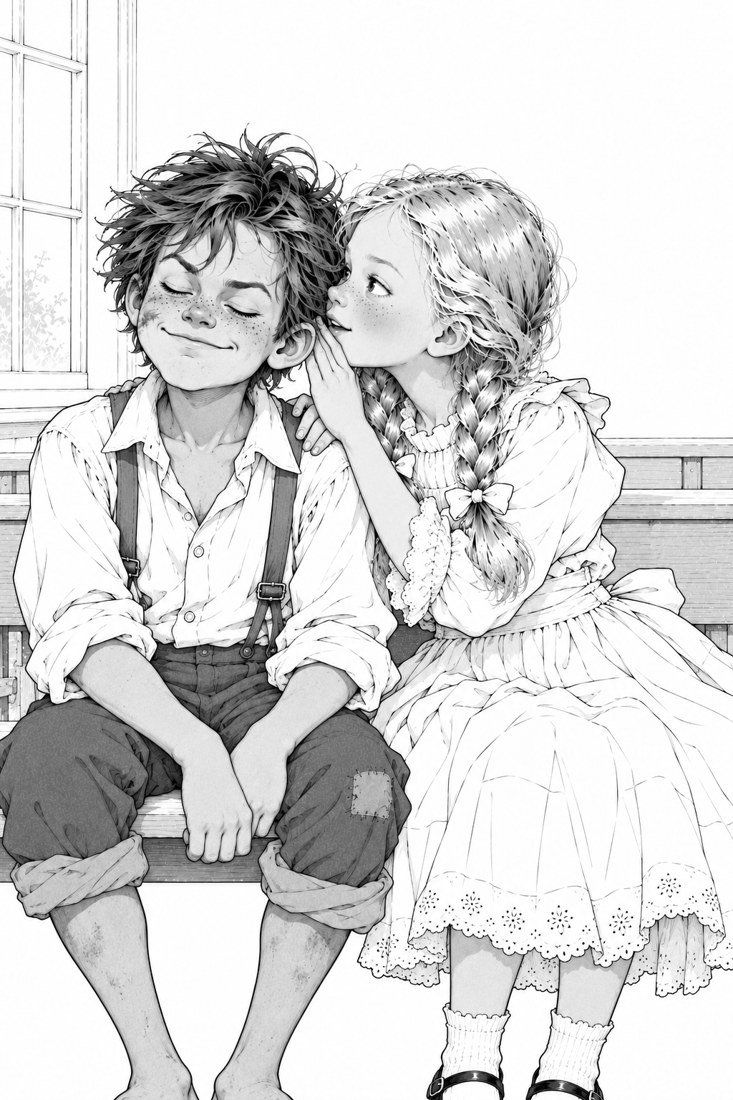
Tom and Becky, the First Courtship
As Mark Twain wrote it, 1876 · Chapter VI, the morning
When Tom reached the little isolated frame school-house, he strode in briskly, with the manner of one who had come with all honest speed. He hung his hat on a peg and flung himself into his seat with business-like alacrity. The master, throned on high in his great splint-bottom arm-chair, was dozing, lulled by the drowsy hum of study. The interruption roused him.
“Thomas Sawyer!”
Tom knew that when his name was pronounced in full, it meant trouble.
“Sir!”
“Come up here. Now, sir, why are you late again, as usual?”
Tom was about to take refuge in a lie, when he saw two long tails of yellow hair hanging down a back that he recognized by the electric sympathy of love; and by that form was the only vacant place on the girls’ side of the school-house. He instantly said:
“I stopped to talk with Huckleberry Finn!”
The master’s pulse stood still, and he stared helplessly. The buzz of study ceased. The pupils wondered if this foolhardy boy had lost his mind. The master said:
“You—you did what?”
“Stopped to talk with Huckleberry Finn.”
There was no mistaking the words.
“Thomas Sawyer, this is the most astounding confession I have ever listened to. No mere ferule will answer for this offence. Take off your jacket.”
The master’s arm performed until it was tired and the stock of switches notably diminished. Then the order followed:
“Now, sir, go and sit with the girls! And let this be a warning to you.”
The titter that rippled around the room appeared to abash the boy, but in reality that result was caused rather more by his worshipful awe of his unknown idol and the dread pleasure that lay in his high good fortune. He sat down upon the end of the pine bench and the girl hitched herself away from him with a toss of her head. Nudges and winks and whispers traversed the room, but Tom sat still, with his arms upon the long, low desk before him, and seemed to study his book.
By and by attention ceased from him, and the accustomed school murmur rose upon the dull air once more. Presently the boy began to steal furtive glances at the girl. She observed it, “made a mouth” at him and gave him the back of her head for the space of a minute. When she cautiously faced around again, a peach lay before her. She thrust it away. Tom gently put it back. She thrust it away again, but with less animosity. Tom patiently returned it to its place. Then she let it remain. Tom scrawled on his slate, “Please take it—I got more.” The girl glanced at the words, but made no sign. Now the boy began to draw something on the slate, hiding his work with his left hand. For a time the girl refused to notice; but her human curiosity presently began to manifest itself by hardly perceptible signs. The boy worked on, apparently unconscious. The girl made a sort of non-committal attempt to see, but the boy did not betray that he was aware of it. At last she gave in and hesitatingly whispered:
“Let me see it.”
Tom partly uncovered a dismal caricature of a house with two gable ends to it and a corkscrew of smoke issuing from the chimney. Then the girl’s interest began to fasten itself upon the work and she forgot everything else. When it was finished, she gazed a moment, then whispered:
“It’s nice—make a man.”
The artist erected a man in the front yard, that resembled a derrick. He could have stepped over the house; but the girl was not hypercritical; she was satisfied with the monster, and whispered:
“It’s a beautiful man—now make me coming along.”
Tom drew an hour-glass with a full moon and straw limbs to it and armed the spreading fingers with a portentous fan. The girl said:
“It’s ever so nice—I wish I could draw.”
“It’s easy,” whispered Tom, “I’ll learn you.”
“Oh, will you? When?”
“At noon. Do you go home to dinner?”
“I’ll stay if you will.”
“Good—that’s a whack. What’s your name?”
“Becky Thatcher. What’s yours? Oh, I know. It’s Thomas Sawyer.”
“That’s the name they lick me by. I’m Tom when I’m good. You call me Tom, will you?”
“Yes.”
Now Tom began to scrawl something on the slate, hiding the words from the girl. But she was not backward this time. She begged to see. Tom said:
“Oh, it ain’t anything.”
“Yes it is.”
“No it ain’t. You don’t want to see.”
“Yes I do, indeed I do. Please let me.”
“You’ll tell.”
“No I won’t—deed and deed and double deed won’t.”
“You won’t tell anybody at all? Ever, as long as you live?”
“No, I won’t ever tell anybody. Now let me.”
“Oh, you don’t want to see!”
“Now that you treat me so, I will see.” And she put her small hand upon his and a little scuffle ensued, Tom pretending to resist in earnest but letting his hand slip by degrees till these words were revealed: “I love you.”
“Oh, you bad thing!” And she hit his hand a smart rap, but reddened and looked pleased, nevertheless.
Just at this juncture the boy felt a slow, fateful grip closing on his ear, and a steady lifting impulse. In that wise he was borne across the house and deposited in his own seat, under a peppering fire of giggles from the whole school. Then the master stood over him during a few awful moments, and finally moved away to his throne without saying a word. But although Tom’s ear tingled, his heart was jubilant.
As the school quieted down Tom made an honest effort to study, but the turmoil within him was too great. In turn he took his place in the reading class and made a botch of it; then in the geography class and turned lakes into mountains, mountains into rivers, and rivers into continents, till chaos was come again; then in the spelling class, and got “turned down,” by a succession of mere baby words, till he brought up at the foot and yielded up the pewter medal which he had worn with ostentation for months.
Chapter VII, that same afternoon
When school broke up at noon, Tom flew to Becky Thatcher, and whispered in her ear:
“Put on your bonnet and let on you’re going home; and when you get to the corner, give the rest of ’em the slip, and turn down through the lane and come back. I’ll go the other way and come it over ’em the same way.”
So the one went off with one group of scholars, and the other with another. In a little while the two met at the bottom of the lane, and when they reached the school they had it all to themselves. Then they sat together, with a slate before them, and Tom gave Becky the pencil and held her hand in his, guiding it, and so created another surprising house. When the interest in art began to wane, the two fell to talking. Tom was swimming in bliss. He said:
“Do you love rats?”
“No! I hate them!”
“Well, I do, too—live ones. But I mean dead ones, to swing round your head with a string.”
“No, I don’t care for rats much, anyway. What I like is chewing-gum.”
“Oh, I should say so! I wish I had some now.”
“Do you? I’ve got some. I’ll let you chew it awhile, but you must give it back to me.”
That was agreeable, so they chewed it turn about, and dangled their legs against the bench in excess of contentment.
“Was you ever at a circus?” said Tom.
“Yes, and my pa’s going to take me again some time, if I’m good.”
“I been to the circus three or four times—lots of times. Church ain’t shucks to a circus. There’s things going on at a circus all the time. I’m going to be a clown in a circus when I grow up.”
“Oh, are you! That will be nice. They’re so lovely, all spotted up.”
“Yes, that’s so. And they get slathers of money—most a dollar a day, Ben Rogers says. Say, Becky, was you ever engaged?”
“What’s that?”
“Why, engaged to be married.”
“No.”
“Would you like to?”
“I reckon so. I don’t know. What is it like?”
“Like? Why it ain’t like anything. You only just tell a boy you won’t ever have anybody but him, ever ever ever, and then you kiss and that’s all. Anybody can do it.”
“Kiss? What do you kiss for?”
“Why, that, you know, is to—well, they always do that.”
“Everybody?”
“Why, yes, everybody that’s in love with each other. Do you remember what I wrote on the slate?”
“Ye—yes.”
“What was it?”
“I sha’n’t tell you.”
“Shall I tell you?”
“Ye—yes—but some other time.”
“No, now.”
“No, not now—to-morrow.”
“Oh, no, now. Please, Becky—I’ll whisper it, I’ll whisper it ever so easy.”
Becky hesitating, Tom took silence for consent, and passed his arm about her waist and whispered the tale ever so softly, with his mouth close to her ear. And then he added:
“Now you whisper it to me—just the same.”
She resisted, for a while, and then said:
“You turn your face away so you can’t see, and then I will. But you mustn’t ever tell anybody—will you, Tom? Now you won’t, will you?”
“No, indeed, indeed I won’t. Now, Becky.”
He turned his face away. She bent timidly around till her breath stirred his curls and whispered, “I—love—you!”
Then she sprang away and ran around and around the desks and benches, with Tom after her, and took refuge in a corner at last, with her little white apron to her face. Tom clasped her about her neck and pleaded:
“Now, Becky, it’s all done—all over but the kiss. Don’t you be afraid of that—it ain’t anything at all. Please, Becky.” And he tugged at her apron and the hands.
By and by she gave up, and let her hands drop; her face, all glowing with the struggle, came up and submitted. Tom kissed the red lips and said:
“Now it’s all done, Becky. And always after this, you know, you ain’t ever to love anybody but me, and you ain’t ever to marry anybody but me, ever never and forever. Will you?”
“No, I’ll never love anybody but you, Tom, and I’ll never marry anybody but you—and you ain’t to ever marry anybody but me, either.”
“Certainly. Of course. That’s part of it. And always coming to school or when we’re going home, you’re to walk with me, when there ain’t anybody looking—and you choose me and I choose you at parties, because that’s the way you do when you’re engaged.”
“It’s so nice. I never heard of it before.”
“Oh, it’s ever so gay! Why, me and Amy Lawrence—”
The big eyes told Tom his blunder and he stopped, confused.
“Oh, Tom! Then I ain’t the first you’ve ever been engaged to!”
The child began to cry. Tom said:
“Oh, don’t cry, Becky, I don’t care for her any more.”
“Yes, you do, Tom—you know you do.”
Tom tried to put his arm about her neck, but she pushed him away and turned her face to the wall, and went on crying. Tom tried again, with soothing words in his mouth, and was repulsed again. Then his pride was up, and he strode away and went outside. He stood about, restless and uneasy, for a while, glancing at the door, every now and then, hoping she would repent and come to find him. But she did not. Then he began to feel badly and fear that he was in the wrong. It was a hard struggle with him to make new advances, now, but he nerved himself to it and entered. She was still standing back there in the corner, sobbing, with her face to the wall. Tom’s heart smote him. He went to her and stood a moment, not knowing exactly how to proceed. Then he said hesitatingly:
“Becky, I—I don’t care for anybody but you.”
No reply—but sobs.
“Becky”—pleadingly. “Becky, won’t you say something?”
More sobs.
Tom got out his chiefest jewel, a brass knob from the top of an andiron, and passed it around her so that she could see it, and said:
“Please, Becky, won’t you take it?”
She struck it to the floor. Then Tom marched out of the house and over the hills and far away, to return to school no more that day. Presently Becky began to suspect. She ran to the door; he was not in sight; she flew around to the play-yard; he was not there. Then she called:
“Tom! Come back, Tom!”
She listened intently, but there was no answer. She had no companions but silence and loneliness. So she sat down to cry again and upbraid herself; and by this time the scholars began to gather again, and she had to hide her griefs and still her broken heart and take up the cross of a long, dreary, aching afternoon, with none among the strangers about her to exchange sorrows with.
The First Courtship, Told Once More
A modern retelling by R. M. Hume
Tom got to school late and walked in fast, like a boy who had hurried the whole way. The master was dozing in his big chair, and the sound of the door woke him.
“Thomas Sawyer!”
Tom knew that the full name meant trouble.
“Come up here. Now, sir, why are you late again?”
He was all set to tell a careful lie when he saw them. Two long tails of yellow hair hanging down a back he had never seen before, and beside that back the one empty seat on the girls’ side of the room. So instead of the lie, the truth came out of him, loud and proud and ruinous.
“I stopped to talk with Huckleberry Finn!”
The whole room went silent. Huckleberry Finn was the one boy in town every mother had forbidden her children to go near, and here was Tom announcing a visit with him as if it were a holiday. The master could hardly speak.
“You did what?”
“Stopped to talk with Huckleberry Finn.”
There was no mistaking it. The master said it was the most astounding confession he had ever heard, that no ruler would answer for a crime this size, and told Tom to take off his jacket. Then he laid on with a switch until his arm was tired and the supply of switches was noticeably shorter, and finished with the sentence Tom had been angling for all along.
“Now, sir, go and sit among the girls!”
The room tittered, and Tom hung his head as if he were ashamed, though what he actually felt was closer to joy. He dropped onto the end of the bench. The girl hitched away from him with a toss of her head. He folded his arms on the desk and pretended to read.
After a while the room forgot about him and went back to its droning. Tom started stealing looks at the girl. She caught him, made a face, and gave him the back of her head for a solid minute. When she turned around again, there was a peach sitting in front of her. She pushed it away. He slid it back. She pushed it away again, with less conviction. He slid it back once more, and this time she let it stay. Then he began drawing something on his slate with a hand curled around it to hide the work, and that was more than her curiosity could bear.
“Let me see it.”
He uncovered a sad little house with two peaked ends and a corkscrew of smoke climbing out of the chimney. She forgot everything else and studied it.
“It’s nice. Make a man.”
He built a man in the front yard who stood taller than the house and looked like a piece of construction equipment. She was not fussy. She liked him.
“It’s a beautiful man. Now make me coming along.”
He drew an hourglass shape with a full moon for a face and straw for arms and legs, and gave the fingers an enormous fan to hold. She admired it and said she wished she could draw.
“It’s easy,” he whispered. “I’ll teach you. At noon. Do you go home for dinner?”
“I’ll stay if you will.”
“Good, that’s a deal. What’s your name?”
“Becky Thatcher. What’s yours? Oh, I know. It’s Thomas Sawyer.”
“That’s the name they lick me by. I’m Tom when I’m good. Call me Tom, will you?”
“Yes.”
Then he started writing something else on the slate, hiding it again, and this time she did not bother pretending she was above it. She begged to see. He held her off and held her off, made her swear she would never tell a living soul, and finally let her pull his hand away a little at a time until the words showed: I love you.
“Oh, you bad thing.” She rapped his hand, but she turned red and she looked pleased.
And right then a slow, awful grip closed on Tom’s ear and lifted. He was walked back across the whole room by that ear and set down in his own seat while the school giggled at him, and the master stood over him a long moment and went back to his chair without a word. Tom’s ear burned, but inside he was singing. He was so far gone that he botched the reading class, turned the geography lesson into nonsense, missed a string of baby words in spelling, and surrendered the little medal he had worn proudly for months. None of it touched him.
When school let out at noon, Tom went straight to Becky and laid out the plan in a whisper. She should put on her bonnet and pretend to walk home, then slip the other children at the corner and double back down the lane; he would go the other way and meet her. It worked. They came together at the bottom of the lane, let themselves into the empty schoolhouse, and had it entirely to themselves. They sat down over a slate, and Tom put the pencil in her hand and covered it with his own and steered it, and together they made another remarkable house. When the drawing ran out, they talked, and Tom was so happy he could hardly hold still.
“Do you love rats?” he said.
“No! I hate them!”
“Well, I do. Live ones. But I mean dead ones, to swing around your head on a string.”
“No, I don’t care for rats. What I like is chewing gum.”
“Oh, me too. I wish I had some right now.”
She had some. She let him chew it a while on the promise that he gave it back, and they passed it turn about and swung their legs against the bench, as content as two people have ever been.
“Were you ever at a circus?” Tom asked.
“Yes, and my pa’s going to take me again if I’m good.”
“I’ve been three or four times. Lots. Church isn’t anything next to a circus. There’s always something going on. I’m going to be a clown when I grow up.”
“Oh, that’ll be nice. They’re so lovely, all spotted up.”
“And they make piles of money. Almost a dollar a day, Ben Rogers says. Say, Becky, were you ever engaged?”
“What’s that?”
“Engaged to be married.”
“No.”
“Would you like to be?”
“I reckon so. I don’t know. What’s it like?”
“It isn’t like anything. You just tell a boy you won’t ever have anybody but him, ever, and then you kiss, and that’s all. Anybody can do it.”
“Kiss? What do you kiss for?”
“Why, that’s, you know. They always do that. Everybody that’s in love. Do you remember what I wrote on the slate?”
“Ye-yes.”
“What was it?”
“I shan’t tell you.”
“Shall I tell you?”
“Yes, but some other time.”
“No, now.”
“No, not now. Tomorrow.”
“Oh, no, now. Please, Becky. I’ll whisper it ever so easy.”
She hesitated, and Tom took that for a yes, put his arm around her waist, and breathed the words into her ear. Then he told her to whisper the same thing back. She held out for a while, then made her terms. He had to turn his face away so he could not see, and he had to swear never to tell anybody.
“No, I never will. Now, Becky.”
He turned away. She leaned timidly around until her breath stirred his hair and whispered, “I love you.” Then she bolted, and ran around and around the desks with Tom chasing, and cornered herself at last with her little apron up over her face. He caught her and pleaded that it was all finished now except the kiss, and the kiss was nothing to be afraid of, and tugged gently at the apron and her hands. By and by she gave up and let her hands fall, and her face came up flushed from the struggle, and Tom kissed her.
“Now it’s all done,” he said. “And from now on you’re never to love anybody but me, and never to marry anybody but me, forever. Will you?”
“No, I’ll never love anybody but you, and I’ll never marry anybody but you, and you’re not to ever marry anybody but me, either.”
“Of course. That’s part of it. And walking to school and home you walk with me, when nobody’s looking, and you pick me and I pick you at parties, because that’s how you do when you’re engaged.”
“It’s so nice. I never heard of it before.”
“Oh, it’s grand. Why, me and Amy Lawrence.”
Her eyes went wide, and Tom saw what he had done and stopped cold.
“Oh, Tom. Then I’m not the first you’ve ever been engaged to.”
And she started to cry.
“Don’t cry, Becky. I don’t care about her anymore.”
“Yes, you do, Tom. You know you do.”
He reached for her and she pushed him off and turned to the wall and cried. He tried again, with every soft word he had, and she turned him away again. So his pride stood up and he walked out. He loitered outside, glancing back at the door, sure she would soften and come looking. She did not. After a while he began to feel like the guilty one. It cost him something to go back in, but he did, and there she still was in the corner, sobbing at the wall. It cut him. He stood beside her, not sure how to begin, and finally got out, “Becky, I don’t care for anybody but you.” Nothing came back but sobs. “Becky, won’t you say something?” More sobs.
So Tom brought out his finest possession, a brass knob off the top of an andiron, and held it where she could see it. “Please, Becky, won’t you take it?”
She knocked it to the floor.
Then Tom marched out of the schoolhouse and over the hills and kept going, done with school for the day. It was only after he was gone that Becky started to wonder. She ran to the door, and he was nowhere in sight; she ran around to the play yard, and he was not there either. She called his name into the quiet and got the quiet back. Then she sat down and cried over him all over again, and blamed herself, and had to pull herself together when the other children started drifting back, and carry a long, aching afternoon with not one friend in all those strangers to tell it to.
What Twain Was Doing
Twain published this in 1876, across the sixth and seventh chapters of The Adventures of Tom Sawyer. The courtship comes in two halves. In the morning Tom wins the seat beside the new girl by the gloriously backward method of telling the truth to the schoolmaster, and courts her over a slate. In the afternoon they meet in the empty schoolhouse and make it official. Twain stages the whole romance in the register of boyhood diplomacy, with treaties, rules, and a formal exchange of vows.
The engine of the scene is that the children borrow the forms of adult love without any of the content. Tom lays out what being engaged requires the way a boy explains the rules of a game he has only heard about, and Becky agrees to terms she does not understand. Twain never steps in to tell you it is funny. He lets the solemnity do the work, and the gap between how grave they are and how small it all is becomes the joke.
Then he turns it, and the turn is the point. One stray boast, Amy Lawrence, and the bliss collapses into real tears. Twain refuses to wink here. He plays Becky’s grief and Tom’s wounded pride exactly as large as the children feel them, and ends not on a punchline but on a girl alone in a corner with no one to tell.
A Note on This Edition
Twain’s text is reproduced verbatim from the 1876 publication. Nothing has been rewritten or modernized. The only additions within the passage are the annotations, which explain words, references, and historical context without changing the underlying text. The retelling below is the only rewritten version. The retelling and these notes were written by R. M. Hume with the help of AI.
Twain splits the first courtship across two chapters, so this edition presents it as he wrote it, in two parts. The first is from the sixth chapter of The Adventures of Tom Sawyer, the morning Tom is sent to sit among the girls and courts Becky on a slate. The second is from the seventh chapter, the afternoon engagement and its collapse. The tick-duel scene that falls between them in the seventh chapter is a separate title, The Tick in School, and is not included here.
This is one of the Tom Sawyer pieces in Mark Twain in an AI World, alongside Whitewashing the Fence, The Pinchbug and the Poodle, The Pain-Killer and the Cat, The Sunday-School Prize, Examination Evening, and The Tick in School. As in the rest of the series, Twain’s own text sits word for word beside a plain modern retelling, so you can see exactly what was changed and what was not.
More on Twain’s method:
How Twain Said to Tell It →
·
The Rulebook Twain Hid in an Insult →